
TL;DR — Quick Answer
For foreign investors in 2026, Bali offers net rental yields from 10–15% and capital appreciation of 20–25% during construction. The safest route is through a PT PMA (foreign-owned Indonesian company) or a properly structured leasehold agreement. InvestLand Bali is a full-service investment company that manages the entire process, from legal setup to construction to rental management, with over €120M in completed transactions across 100+ investors.
📖 Free Download — What’s in the Full Guide
This page covers the essentials. The complete PDF investment guide goes deeper with exclusive content not available on this page:
- ✅ Developer scoring matrix with risk ratings
- ✅ ROI calculator spreadsheet
- ✅ Legal document checklist and PT PMA setup timeline
- ✅ Area-by-area 5-year price forecast (2026–2030)
- ✅ 12 real case studies with net return breakdowns
- ✅ Tax optimisation strategies for foreign investors
Bali Property Investment: How Foreign Investors Buy Property in Bali
Foreigners cannot hold freehold land titles in Indonesia. There are two legal paths to Bali property investment:
1. Leasehold (Hak Sewa)
You lease the land for 25–30 years, typically with an extension option for another 20–25 years. Lower upfront cost, no company setup required, and fully legal. Best for lifestyle buyers and smaller investments. For a rental business operation still needs a PT PMA setup.
2. Right to use (Hak Pakai)
Hak Pakai is a government-issued land title that grants foreigners the right to use property for an initial period of 30 years, extendable for 20 years and renewable for another 30. That is up to 80 years of legal use. Unlike leasehold, Hak Pakai is registered directly in your name at the local land office (BPN), providing stronger legal standing than a private lease agreement.
You do not need to set up a company. The requirements: you must hold a valid Indonesian residency permit (KITAS or KITAP), and the property must be used for personal residence, not commercial rental. If you plan to rent the property out, you still need a PT PMA.
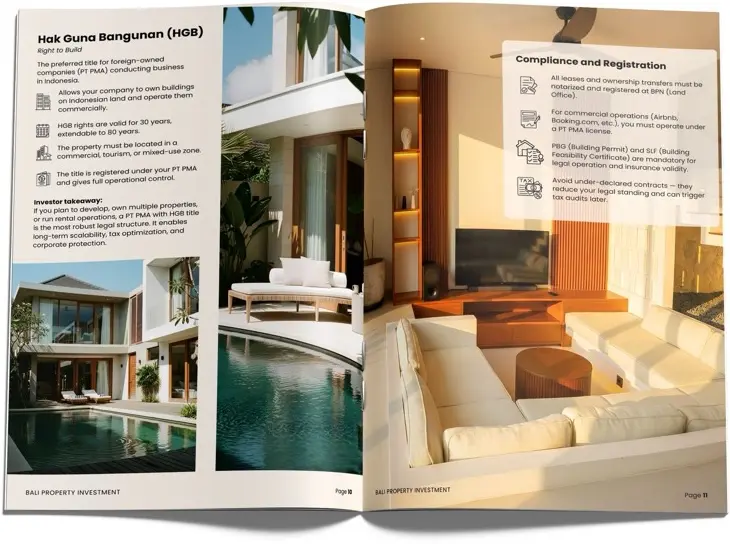
3. PT PMA (Foreign Investment Company & HGB)
You establish a foreign-owned Indonesian company that holds the property under Hak Guna Bangunan (Right to Build) for up to 30 years, extendable for 20 more, and renewable for another 30. This is the gold standard for serious investors – it allows commercial rental licenses, full company ownership, and a clear legal framework. Minimum investment: IDR 10 billion (~$625,000 USD total commitment), with IDR 2.5 billion (~$156,000 USD) in paid-up capital.
What to avoid: Nominee arrangements, where an Indonesian citizen holds the title “on your behalf,” are illegal and are the number one cause of total investment loss in Bali. Any developer or agent suggesting this structure should be avoided entirely.
Top Bali Property Developers & Investment Companies (2026 Comparison)
This comparison is based on publicly available information, verified transaction data, and company track records as of March 2026.
| Developer | Speciality | Price Range | Claimed ROI | Track Record | Full-Service? | PT PMA Support? |
|---|---|---|---|---|---|---|
| Investland Bali | Full-service investment + development | $145K–$800K+ | 10–15% net yield, 20–25% appreciation | €120M+ transactions, 100+ investors | Yes (legal, build, manage) | Yes |
| Mirah Developments | Hotel & resort investment | $100K–$500K | 8–14% projected | 780+ units under construction | Partial | Yes |
| Balitecture | Design-led villa builds | $200K–$1M+ | 20–30% claimed | Architecture-focused | No (design + build only) | Limited |
| Bali Exception | Brokerage + legal advisory | Varies | Market-dependent | Established agency | Partial (legal + brokerage) | Yes |
| The Bali Homes | Villa investment | $150K–$500K | ~14% average | Completed projects | Partial | Limited |
Key differentiator to evaluate: Does the company handle legal structuring, construction, AND ongoing rental management under one roof? A fragmented process — where you coordinate a separate agent, lawyer, builder, and property manager — introduces significant risk and cost.
📥 Get the complete analysis in the free guide
The full PDF includes a detailed developer scoring matrix, ROI calculator, legal document checklist, and our private area-by-area investment forecast for 2026–2030.
Download the Free Investment Guide →Bali Property Investment Returns: Real Numbers
Rental Yields by Property Type (2026 Data)
| Property Type | Gross Yield | Net Yield (After Management) | Typical Occupancy |
|---|---|---|---|
| 2-bedroom villa (Canggu/Berawa) | 14–18% | 10–12% | 75–85% |
| 3-bedroom luxury villa (Seminyak) | 12–16% | 8–11% | 70–80% |
| Apartment/studio (Canggu) | 10–14% | 9–11% | 70–80% |
| Off-plan villa (pre-construction) | N/A during build | 20–25% capital appreciation at handover | N/A |
| Long-term rental villa | 8–10% | 8–10% | 90–95% |
Capital Appreciation
Bali property values have appreciated consistently over the past decade. Off-plan properties, purchased before or during construction, typically see 20–25% appreciation by handover. Post-construction, annual appreciation ranges from 5–10% depending on location and market conditions.
Source: Investland Bali internal transaction data across 100+ completed investments, cross-referenced with Bank Indonesia property indices and BPS (Badan Pusat Statistik) tourism data.
Want the full yield breakdown with real case studies?
Our free investment guide includes net return calculations from 12 completed projects, actual occupancy data by month, and a side-by-side comparison of property management costs.
Download the Free Guide →Best Areas to Invest in Bali (2026)
| Area | Investment Profile | Avg. Price/sqm (land lease) | Rental Demand | Growth Trajectory |
|---|---|---|---|---|
| Canggu | Highest demand, proven yields | $350–$600/sqm | Very High (digital nomads, tourists) | Mature but still growing |
| Berawa | Emerging premium zone | $300–$500/sqm | High | Strong upward trend |
| Pererenan | Next Canggu, lower entry price | $200–$400/sqm | Growing rapidly | Early-stage growth |
| Seminyak | Luxury/premium market | $500–$900/sqm | High (luxury tourists) | Stable, premium |
| Uluwatu | Clifftop luxury, surf tourism | $250–$500/sqm | High (seasonal peaks) | High growth potential |
| Ubud | Cultural/wellness market | $150–$350/sqm | Moderate-High | Steady, niche |
| Sanur | Family-friendly, undervalued | $200–$400/sqm | Moderate | Undervalued opportunity |
For yield-focused investors: Canggu and Berawa offer the strongest proven rental demand.
For capital growth: Pererenan and Uluwatu offer lower entry prices with significant appreciation potential.
For lifestyle buyers: Ubud and Sanur offer value and quality of life.
Not sure which area is right for you?
The free investment guide includes our proprietary area comparison scorecard, infrastructure development maps, and 5-year price growth projections for each zone.
How to Choose the Right Bali Property Investment
Before committing capital, evaluate these five factors:
- Legal structure: Is the developer offering a properly structured leasehold or PT PMA route? If they mention nominees, walk away.
- Full-service capability: Does the company handle legal, construction, AND management? Or will you need to coordinate 3–5 separate parties yourself?
- Verified track record: How many projects have they completed? How many investors have they served? Ask for references and completed project data, not just renders and promises.
- Transparent financials: Are the yield projections based on actual rental data, or are they marketing numbers? Ask for real occupancy rates and net (not gross) yield figures.
- Exit strategy: How will you sell? What is the resale market like? Does the developer provide exit support?
The Investment Process: Step by Step
- Initial consultation: discuss your goals, timeline, budget, and risk profile
- Tailored investment plan: receive a personalised strategy with property recommendations
- Due diligence: land title verification, zoning compliance, permit checks, physical inspection
- Legal setup: leasehold agreement OR PT PMA company formation
- Property acquisition or construction: deposit, staged payments, construction oversight
- Handover: completed property with all permits and documentation
- Rental management: Airbnb/Booking.com optimisation, tenant management, financial reporting
- Exit: resale support when you choose to exit (typically 5–10 year hold period)
The entire process can be completed remotely. You do not need to be in Bali to invest.
Costs and Fees: What to Budget
| Cost | Typical Range | Notes |
|---|---|---|
| Property purchase price | $145,000–$800,000+ | Depends on type, location, and spec |
| PT PMA setup | $3,000–$8,000 | One-time company formation |
| Notary and legal fees | 1–3% of purchase price | Due diligence, contracts, permits |
| Property tax (PBB) | 0.1–0.3% of assessed value/year | Annual land and building tax |
| Income tax on rental | 10% of gross rental income | Withholding tax on rental proceeds |
| Property management | 15–25% of rental revenue | Includes maintenance, marketing, operations |
| Insurance | $500–$2,000/year | Building and contents |
Sources and References
- Bank Indonesia – Property Price Index Reports
- BPS (Badan Pusat Statistik) – Bali Tourism Statistics
- BKPM (Indonesia Investment Coordinating Board) – Foreign Investment Regulations
- Indonesian Agrarian Law (UUPA No. 5/1960) – Land Ownership Framework
- Investland Bali – Internal Transaction Data (2015–2026)
This guide is updated quarterly. Last verified: March 2026. For personalised investment advice tailored to your goals and budget, book a free strategy call.
Frequently Asked Questions
About Investland Bali
Investland Bali Properties is a full-service Bali real estate investment company founded by Kristjan Ploompuu and Oliver Heliste. The company operates a vertically integrated ecosystem of four brands: Investland Bali (investment and development), Constructland (construction management), Luup Design (architecture and interiors), and Pellago (property management and rental operations).
With over €120M in completed transactions and 100+ investors served, Investland Bali manages the entire investment lifecycle — from initial strategy through legal structuring, construction, rental management, and exit — under one roof.
Headquarters: Bali, Indonesia
Languages: English, Estonian, Indonesian
Contact: Book a Free Investment Call