
Moving to Bali in 2026: The Practical Relocation Guide


Moving to Bali in 2026 requires a valid long-term visa (B211A, KITAS, or E33G digital nomad visa), a monthly budget of $1,500 to $3,500 depending on lifestyle, and an understanding of the 183-day tax residency rule that triggers worldwide income taxation. The process takes 4 to 12 weeks from decision to arrival. Over 600,000 foreign residents now call Bali home. Investland Bali has helped 100+ international investors relocate and establish property holdings on the island.
Bali is no longer just a holiday destination. The island has become a permanent base for remote workers, entrepreneurs, retirees, and families from over 80 countries. The expat population has grown past 600,000, supported by international schools, accredited hospitals, fast internet infrastructure, and a cost of living 40 to 60% below Western cities.
This guide covers the practical steps: visas, costs, healthcare, schools, tax obligations, where to live, and what most guides leave out. It is based on the real experience of Investland Bali's team and the 100+ investors who have made the move.
Step 1: Choose the Right Visa

Your visa determines how long you can stay, whether you can work, and what tax obligations apply. Bali offers several long-term visa options for foreigners. The table below compares the most common routes.
Visa Comparison Table (2026)
| Visa Type | Duration | Cost (approx.) | Work Permitted | Best For |
|---|---|---|---|---|
| Visa on Arrival (VoA) | 30 days, extendable to 60 | $35 + $35 extension | No | Short visits, scouting trips |
| B211A (Social/Business) | 60 days, extendable to 180 | $300 to $500 total | No (networking only) | Extended stays, exploring before committing |
| E33G (Digital Nomad KITAS) | 1 year, renewable up to 5x | $600 to $800 | Yes (remote work for foreign employer only) | Remote workers, freelancers earning $60,000+/year |
| Investor KITAS | 1 to 2 years, renewable | $1,500 to $3,000 | Yes (through your PT PMA) | Property investors, business owners |
| Retirement KITAS | 1 year, renewable | $1,200 to $2,000 | No | Retirees aged 55+ with proof of pension/savings |
| Second Home Visa | 5 to 10 years | $2,000 to $3,500 | Limited | High-net-worth individuals with $130,000+ in savings |
The most common starting point is the B211A. It gives you up to 180 days to explore, find accommodation, and decide whether Bali is right for you before committing to a longer-term visa.
For remote workers, the E33G digital nomad visa is the legal route. It requires proof of $60,000+ annual income, a foreign employment contract, and takes 2 to 4 weeks to process. Working on a tourist visa is illegal, and immigration enforcement tightened significantly in 2025 and 2026.
For property investors, the Investor KITAS is issued through your PT PMA company. If you are setting up a PT PMA for real estate investment, the KITAS application runs alongside the company formation process.
For retirees, Bali offers a dedicated retirement visa. The requirements, costs, and lifestyle considerations are covered in our retirement in Bali guide.
Step 2: Budget Realistically

The cost of living in Bali depends entirely on your lifestyle choices. The numbers below reflect actual monthly spending for a single expat in 2026.
Monthly Budget Comparison (Single Expat, 2026)
| Category | Budget ($1,500/mo) | Comfortable ($2,500/mo) | Premium ($3,500+/mo) |
|---|---|---|---|
| Accommodation | $400 (shared villa/room) | $800 (private 1-bed villa) | $1,500+ (2-bed pool villa) |
| Food and dining | $300 (mostly warungs) | $500 (mix of local and Western) | $700+ (restaurants, delivery) |
| Transport | $80 (scooter rental) | $150 (scooter + occasional Grab) | $300 (car + driver) |
| Utilities and internet | $80 | $150 | $200 |
| Health insurance | $100 (basic) | $200 (mid-range) | $400+ (comprehensive) |
| Entertainment | $100 | $250 | $400+ |
| Visa costs (monthly avg) | $50 | $100 | $150 |
| Gym/wellness | $50 | $100 | $200 |
| Total | $1,160 | $2,250 | $3,450+ |
Couples typically spend 1.5x a single budget, not 2x, because accommodation, transport, and utilities are shared. Families with children should add $500 to $2,500 per month for international school fees depending on the school.
The most common budget mistake is underestimating dining costs if you eat primarily Western food. Warungs (local restaurants) serve full meals for $1 to $3. Western restaurants charge $8 to $25 per plate. The gap compounds quickly over a month.
For the full breakdown with 2026 pricing, see our cost of living in Bali guide.
Step 3: Pick Your Area
Each area of Bali attracts a different type of resident. The right choice depends on your lifestyle, budget, and whether you have children.
Area Comparison for Expats
| Area | Monthly Rent (1-bed villa) | Vibe | Best For | Internet Speed |
|---|---|---|---|---|
| Canggu/Berawa | $600 to $1,200 | Energetic, social, busy | Digital nomads, young professionals | 50 to 100 Mbps |
| Seminyak | $800 to $1,500 | Urban, nightlife, dining | Social expats, hospitality workers | 50 to 100 Mbps |
| Uluwatu/Bukit | $500 to $1,000 | Quiet cliffs, surf culture | Surfers, couples, remote workers | 30 to 80 Mbps |
| Ubud | $400 to $900 | Cultural, green, spiritual | Families, wellness seekers, artists | 20 to 60 Mbps |
| Sanur | $400 to $800 | Calm, family-friendly, flat | Families with young children, retirees | 30 to 80 Mbps |
| Pererenan | $500 to $900 | Quiet Canggu alternative | People who want proximity without the noise | 40 to 80 Mbps |
Canggu is where most first-time expats land. It has the highest concentration of co-working spaces, Western restaurants, and social infrastructure. It is also the busiest and most developed. Traffic during peak hours is a real consideration.
Ubud attracts families and creatives. It is quieter, greener, and more affordable. The trade-off is distance from the beach and fewer Western conveniences.
Sanur is the most family-friendly area on the island. Flat terrain (safe for cycling with kids), calm beaches, proximity to international clinics, and a quieter pace of life make it popular with families and retirees.
For a detailed area-by-area guide with investment context, see which region of Bali reflects your lifestyle.
Step 4: Arrange Healthcare
Healthcare in Bali has improved significantly over the past decade. The island now has international-standard hospitals and clinics that serve the expatriate population.
BIMC Siloam Hospital operates facilities in Kuta, Nusa Dua, and Ubud. It is the first hospital in Indonesia accredited by the Australian Council on Healthcare Standards International (ACHSI) and won a Healthcare Asia Award in 2026. BIMC handles most expat medical needs from general practice to emergency surgery.
Siloam Hospitals (the broader group) operates across Bali and Indonesia, providing specialist care, diagnostics, and inpatient services at international standards.
For routine care, most expats register with a local GP or international clinic in their area. Consultations typically cost $20 to $50 without insurance.
Health insurance is not optional. Indonesian public healthcare is not designed for expatriates and language barriers can complicate treatment. International health insurance plans covering Indonesia range from $100 to $400 per month depending on coverage level, age, and pre-existing conditions. Providers like Pacific Prime, Cigna, and Allianz offer plans specifically designed for Bali-based expats.
Dental and specialist care is widely available and significantly cheaper than Western countries. A dental cleaning costs $20 to $40. Complex dental work runs 50 to 70% less than equivalent treatment in Australia, the UK, or the US.
Emergency evacuation coverage is worth considering. While Bali handles most medical needs, some specialist procedures may require transfer to Singapore or Jakarta. Evacuation coverage typically costs $50 to $100 per year on top of standard health insurance.
Step 5: Sort Schools (If You Have Children)

Bali hosts over 20 international schools offering International Baccalaureate (IB), Cambridge International, Australian, and national curricula. Quality has improved steadily as the expat population has grown.
Green School Bali (Badung) is the most well-known, offering a bamboo campus, environmental curriculum, and IB programmes. Annual tuition: $12,000 to $22,000 depending on year level.
Bali Island School (Sanur) offers IB from early years through diploma. It is one of the longest-established international schools on the island. Annual tuition: $8,000 to $18,000.
Canggu Community School serves the Canggu corridor with Cambridge curriculum and a strong expat community. Annual tuition: $6,000 to $14,000.
Other notable schools include Australian Independent School (AIS), Dyatmika School, and several Montessori and Waldorf options for younger children.
Most international schools have waiting lists for the start of the academic year (August/September). Apply 3 to 6 months in advance. Some schools offer mid-year entry depending on availability.
For a detailed comparison of curricula, tuition, and locations, see our guide to international schools in Bali.
Step 6: Understand Your Tax Obligations
Tax is the topic most expats ignore until it becomes a problem. Two rules matter.
The 183-day rule. If you spend more than 183 days in Indonesia within any rolling 12-month period, Indonesia considers you a tax resident. Tax residents are liable for worldwide income at progressive rates up to 35%. This is not based on a calendar year but on a rolling lookback period. Every day you are physically present in Indonesia counts.
E33G visa holders are specifically exempt from Indonesian income tax on foreign-sourced income for the first four years of tax residency, provided they meet certain skill requirements. After four years, standard worldwide taxation applies.
Non-residents (under 183 days) are taxed only on Indonesian-sourced income.
Indonesia Personal Income Tax Rates (2026)
| Annual Taxable Income (IDR) | Rate |
|---|---|
| Up to 60 million ($3,600) | 5% |
| 60M to 250M ($3,600 to $15,000) | 15% |
| 250M to 500M ($15,000 to $30,000) | 25% |
| 500M to 5B ($30,000 to $300,000) | 30% |
| Above 5B ($300,000+) | 35% |
Important: if you hold a PT PMA for property investment, the company is a separate tax entity. Corporate income tax is 22% on profit. Personal tax applies to salary and dividends drawn from the PT PMA. Get a qualified Indonesian tax advisor before crossing the 183-day threshold. The cost of professional tax advice ($500 to $1,500 per year) is trivial compared to the risk of non-compliance.
Step 7: Prepare Before You Arrive

A smooth transition depends on preparation. This checklist covers the practical items most people miss.
Documents to prepare:
- Passport valid for at least 12 months beyond your planned arrival
- Visa documentation (B211A application, or KITAS sponsorship if applicable)
- International driving permit (IDP) from your home country (required for legal scooter/car rental)
- Certified copies of marriage and birth certificates (needed for school enrolment and dependent visas)
- Health insurance policy active from day one
- Bank statements (required for certain visa types and accommodation rentals)
Financial setup:
- Notify your home bank of extended overseas travel to prevent card blocks
- Set up a Wise (formerly TransferWise) or similar multi-currency account for IDR transfers
- Bring a backup debit/credit card from a different bank
- Budget for the first 3 months of living costs in accessible savings (not locked investments)
On arrival:
- Get a local SIM card (Telkomsel or XL have the best coverage across Bali)
- Download Grab (ride-hailing), Gojek (ride-hailing and food delivery), and Tokopedia (online shopping)
- Register with the local banjar (village council) through your landlord or property manager
- Find a local GP or register at BIMC for medical records
- Open an Indonesian bank account if staying long-term (BCA, Mandiri, or CIMB Niaga are the most expat-friendly)
Step 8: Consider Property Investment

Many expats who move to Bali eventually invest in property, either as a primary residence or as a rental investment. The transition from renting to owning typically happens after 6 to 12 months of living on the island, once you understand the areas, the market, and the legal framework.
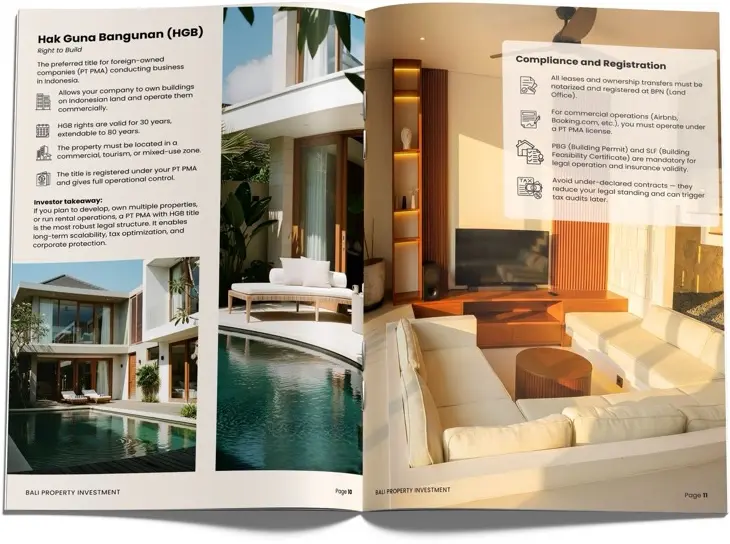
Foreign property ownership in Bali requires a PT PMA (foreign-owned company) that holds the title under Right to Build (HGB). Setup costs $3,000 to $8,000 with a paid-up capital requirement of IDR 2.5 billion under BKPM Regulation 5/2025. The full process is covered in our PT PMA Bali guide.
Entry-level one-bedroom villas start at $145,000. Two-bedroom villas in Canggu or Uluwatu range from $240,000 to $350,000. Net rental yields for professionally managed properties run 10 to 15% per annum.
Investland Bali has structured 120M+ EUR in property transactions for 100+ investors across 15+ countries. The team covers strategy, acquisition, construction (through Constructland), architecture (through Luup.design), and property management (through Pellago). Whether you are buying your first villa or building a rental portfolio, the process starts with understanding how foreigners buy property in Bali.
What Expats Wish They Knew Before Moving
Five things that do not appear in most relocation guides.
Traffic is real. Canggu, Seminyak, and the airport corridor have significant traffic congestion during peak hours (7 to 9 AM, 4 to 7 PM). Plan your accommodation around your daily routine, not just the nearest beach.
Wet season is not a dealbreaker. November to March brings afternoon rain, not all-day downpours. Most days have clear mornings. The wet season is quieter, cheaper, and still warm (27 to 30 degrees Celsius). Many long-term expats prefer it.
Learn basic Bahasa Indonesia. English is widely spoken in tourist areas, but basic Indonesian goes a long way in daily life, negotiations, and building relationships with Balinese neighbours. "Terima kasih" (thank you), "berapa harganya" (how much), and "selamat pagi" (good morning) are a good start.
The expat bubble is optional. Bali has a large international community with Facebook groups, regular meetups, co-working events, and social clubs. But the best part of living in Bali is engaging with Balinese culture. Attend a ceremony. Learn about the temple calendar. Understand the banjar system. The island gives back what you put in.
Internet is good enough. Fibre connections delivering 50 to 100 Mbps are available in Canggu, Seminyak, and Sanur. Starlink is increasingly common in areas with weaker infrastructure. Most digital nomads and remote workers have no connectivity issues for video calls and large file transfers.
Your Next Step
Moving to Bali starts with understanding whether it fits your life, your finances, and your goals. If property investment is part of the plan, Investland Bali can walk you through the market, the legal structure, and the realistic numbers before you commit.
Download our free Bali Investment Guide for the full relocation and investment framework, or book a 30-minute strategy call with our team for a specific assessment of your position. The same team that has helped 100+ investors relocate and invest across 15+ countries.
Sources:
1. PwC Indonesia — Individual Taxes on Personal Income
3. Indonesia E33G Remote Worker KITAS — requirements
4. Grant Thornton — Expatriate Tax Indonesia