
Can Foreigners Own Land in Bali? Hak Pakai, Leasehold & PT PMA


Can Foreigners Own Land in Bali? Hak Pakai, Leasehold & PT PMA
Foreigners cannot own freehold land (Hak Milik) in Bali, which Indonesia's Basic Agrarian Law No. 5 of 1960 reserves for Indonesian citizens. Three legal routes exist instead: leasehold for 25-30 years, Hak Pakai (right to use) for up to 80 years, and HGB title held through a foreign-owned PT PMA company, also up to 80 years.
Last updated: 21 July 2026
Key facts at a glance
- Freehold (Hak Milik) is closed to foreigners under the Basic Agrarian Law No. 5 of 1960. No exceptions, no workarounds.
- Leasehold (Hak Sewa) typically runs 25-30 years with a negotiated extension, and is the structure behind roughly 7 in 10 Bali listings.
- Hak Pakai gives residency-permit holders a registered title for up to 80 years (30 + 20 + 30), with a minimum purchase price of IDR 5 billion for a landed house in Bali.
- HGB through a PT PMA also runs up to 80 years (30 + 20 + 30) and lets the property operate as a licensed rental business.
- A PT PMA requires IDR 2.5 billion (about $150,000) paid-up capital under Minister of Investment Regulation No. 5 of 2025 and takes 4-6 weeks to set up. Investland has completed 60+ PT PMA setups since 2022.
The question every international buyer asks first has a clean legal answer, and most of the confusion around it is manufactured by people selling shortcuts. Foreign land ownership in Bali is not a grey area. The law says exactly what a foreigner can hold, for how long, and under which conditions, and all three legal structures are registered with Indonesia's land office (BPN). This guide sets out each route with its real terms, real costs and real limits, drawn from the 120+ foreign purchases Investland has structured since 2022, so you can pick the one that fits how you plan to use the property.

Can foreigners own land in Bali? The short answer
Foreigners cannot hold Hak Milik, Indonesia's freehold title, in Bali or anywhere else in the country. The Basic Agrarian Law No. 5 of 1960 restricts freehold to Indonesian citizens. What foreigners can legally hold is a lease (Hak Sewa), a right-to-use title (Hak Pakai), or building rights (HGB) through an Indonesian company they own, a PT PMA.

The distinction that matters is between the land and the rights over it. Indonesia never sells its land to foreign nationals, but it grants long, registered, renewable rights that behave like ownership in practice: you can build, rent out, sell the structure and transfer the right. Every legitimate foreign purchase in Bali is one of these three structures. Anything presented as "freehold for foreigners" is either an HGB structure being loosely described, or a nominee arrangement, which we cover below because it is the one route that genuinely puts your capital at risk.
One more legal layer sits above the title: zoning. A correct title on wrongly zoned land still cannot be built on or rented out legally. Our guide to Bali land zones explains how to check zoning before any money moves.
Leasehold (Hak Sewa): the most common route
Leasehold is a contract giving you exclusive use of land and buildings for a fixed term, typically 25-30 years in Bali, usually with a pre-agreed extension option. It is the simplest and cheapest structure, requires no residency permit and no company, and is the structure behind roughly 70% of Bali's for-sale listings.

The economics are straightforward: you pay the full lease value upfront, the price reflects the remaining term, and the asset is a wasting one unless you extend. The two clauses that decide whether a leasehold is well bought are the extension clause, which should fix the mechanism and ideally the pricing formula for renewal, and the transfer clause, which must allow you to sell or assign the remaining term without the landowner's open-ended discretion. A 27-year lease with a clean, priced extension option is a materially better asset than a 30-year lease without one.
Leasehold suits investors who want the lowest entry cost and a defined horizon. On a typical Canggu two-bedroom, our managed portfolio shows realistic net yields of 7-11%, which against a leasehold entry price is where Bali's headline returns come from. Returns are not guaranteed and depend on market conditions, property type, and management. What leasehold does not give you is a registered title at the land office; your protection is contractual, which is why the notarised lease deed and proper due diligence on the underlying certificate are non-negotiable.
Hak Pakai: the registered right-to-use title
Hak Pakai is a land title registered in a foreigner's own name at the BPN land office, granted for 30 years, extendable by 20 and renewable for another 30, up to 80 years in total under Government Regulation No. 18 of 2021. It is the only structure where an individual foreigner's name appears on an Indonesian land certificate.

The conditions are specific. You need a valid Indonesian residency permit (KITAS or KITAP), the land must carry the right underlying certificate, and the property must clear a minimum purchase price set per province: for Bali, IDR 5 billion (about $300,000) for a landed house and IDR 2 billion for an apartment, under the Agrarian Ministry's 2022 price-floor decree. The title is inheritable and mortgageable in principle, and it converts back cleanly if you sell to an Indonesian citizen.
In practice Hak Pakai fits a narrower group than the brochures suggest: residents who live in the property, want their own name on the certificate, and are buying above the price floor. It is a personal-use title, not a business one. If the plan is to run the villa as a short-term rental with licences and staff, the structure below fits better. For how residency permits themselves work alongside a purchase, see our pillar on how foreigners buy property in Bali.
HGB through a PT PMA: the closest thing to ownership
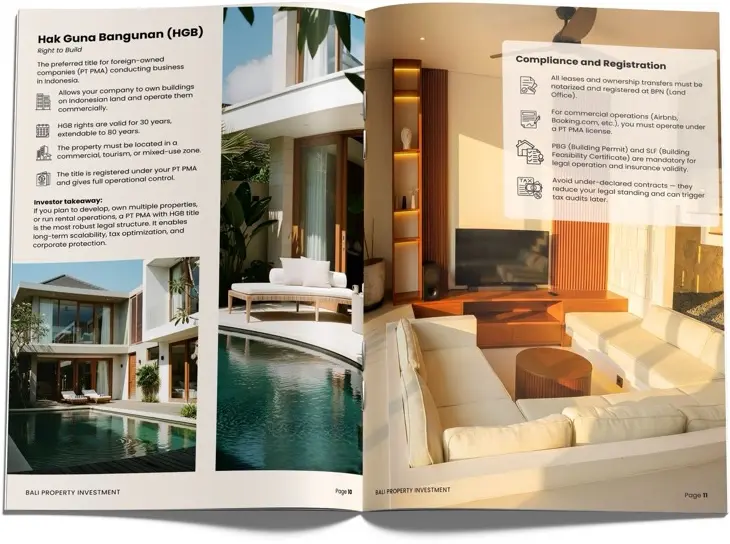
A PT PMA is a foreign-owned Indonesian limited company, and it can hold HGB (right-to-build) title for 30 years, extendable by 20 and renewable for 30, up to 80 years. Because the company is Indonesian and you own the company, this is the structure that comes closest to genuine ownership, and the only one built for running a rental business legally.

The numbers, from the 60+ PT PMA setups Investland has completed since 2022, are these. Paid-up capital is IDR 2.5 billion, about $150,000, under Minister of Investment Regulation No. 5 of 2025, in force since October 2025. The stated investment plan is IDR 10 billion per business classification (KBLI), excluding land and buildings. Setup through the OSS licensing system takes 4-6 weeks. The paid-up capital is not a fee: it stays inside your company and is typically deployed into the property itself.
| PT PMA line item | Figure | Notes |
|---|---|---|
| Paid-up capital | IDR 2.5 billion (~$150,000) | Min. of Investment Reg. No. 5/2025; stays in your company, usually deployed into the property |
| Investment plan | IDR 10 billion per KBLI | Commitment excluding land and buildings, declared via OSS |
| Setup time | 4-6 weeks | Deed, ministry approval, NIB and licences via OSS |
| HGB term | 30 + 20 + 30 years | Up to 80 years, registered at BPN in the company's name |
| Rental licensing | Via the company | The PT PMA holds the hospitality licences; income is taxed in Indonesia |
The trade-off is obligation. A PT PMA files monthly tax reports and quarterly investment reports (LKPM), needs a registered address and costs real money in annual compliance. It earns its keep when the property is a business: multiple units, short-term rental income, staff, or a build-to-sell plan. For a single villa used a few weeks a year, it is usually over-structured. The full setup process, costs and compliance calendar are in our dedicated PT PMA guide.
Which structure fits which investor
The decision reduces to three questions: do you hold an Indonesian residency permit, is the property a business or a home, and how long is your horizon? Leasehold wins on entry cost and simplicity, Hak Pakai on personal title for residents, and HGB via PT PMA on control, duration and legal rental operation.

| Leasehold (Hak Sewa) | Hak Pakai | HGB via PT PMA | |
|---|---|---|---|
| Maximum term | 25-30 yrs + extension | 80 yrs (30+20+30) | 80 yrs (30+20+30) |
| Registered title in your name | No, contractual right | Yes, personal | Yes, via your company |
| Residency permit required | No | Yes (KITAS/KITAP) | No |
| Minimum price threshold | None | IDR 5B house / 2B apartment (Bali) | None, but IDR 2.5B capital |
| Legal short-term rental business | Limited, via operator | No, personal use | Yes, licensed |
| Entry and running cost | Lowest | Middle | Highest, ongoing compliance |
| Typical fit | First investment, defined horizon | Resident owner-occupier | Rental business, multiple units, long hold |
Transaction costs apply on top of every route: BPHTB acquisition tax at 5% of assessed value, notary and PPAT fees at 1-2.5%, and legal due diligence, landing total costs at 8-12% of the purchase price. Whichever structure you choose, budget for it before you shortlist properties, not after.
Not sure which structure fits your situation? Book a free call with Kristjan and we will map the right route for your residency status, budget and rental plans in 30 minutes.
The nominee shortcut, and why it fails
A nominee arrangement puts freehold land in an Indonesian citizen's name on your behalf, usually wrapped in side agreements. Indonesian courts have repeatedly voided these structures, because Article 26 of the Agrarian Law nullifies transfers designed to move Hak Milik to a foreigner, and when the structure fails, the money is not returned.

The pitch is always the same: full freehold, your name hidden behind a trusted local, a stack of powers of attorney and loan agreements as protection. The problem is that the entire paper stack exists to achieve something the law prohibits, so none of it is enforceable when tested. The Supreme Court has sided with the registered Indonesian owner in the landmark cases, and the foreign buyer's payment is treated as forfeited. In a market where a legal 80-year registered structure exists for the price of proper setup, taking uncompensated legal risk to hold a title you cannot defend is a bad trade. Every structure Investland has used across 120+ foreign purchases is one of the three legal routes above, and that is not a marketing position, it is risk management.
Frequently asked questions
Can a foreigner own freehold land in Bali?
No. Freehold title (Hak Milik) is restricted to Indonesian citizens under the Basic Agrarian Law No. 5 of 1960. Foreigners legally hold land through leasehold contracts, a Hak Pakai right-to-use title, or HGB building rights held by a foreign-owned PT PMA company. Any offer of direct freehold to a foreigner is not enforceable.
How long can a foreigner lease land in Bali?
Typical Bali leaseholds run 25-30 years, with extensions negotiated in the original deed. There is no statutory maximum for lease terms, so the practical ceiling is what the landowner will sign. The value of a leasehold tracks its remaining years, which makes the extension clause the most important line in the contract.
What is Hak Pakai and who qualifies for it?
Hak Pakai is a right-to-use title registered in a foreigner's own name, granted for 30 years and extendable to 80. It requires a valid KITAS or KITAP residency permit and a property above Bali's price floor, IDR 5 billion for a landed house or IDR 2 billion for an apartment. It suits resident owner-occupiers, not rental businesses.
Can a PT PMA own land in Bali?
A PT PMA cannot hold freehold, but it can hold HGB (right-to-build) title for up to 80 years, registered in the company's name. Since the foreigner owns the company, this is the closest legal equivalent to ownership and the only structure that supports a licensed short-term rental business.
How much does a PT PMA cost to set up?
Under Minister of Investment Regulation No. 5 of 2025, a PT PMA needs IDR 2.5 billion (about $150,000) in paid-up capital plus a declared IDR 10 billion investment plan per business line. Setup takes 4-6 weeks through the OSS system. The capital is not a fee, it stays in your company and is typically deployed into the property.
Is nominee ownership legal in Bali?
No. Using an Indonesian citizen's name to hold freehold for a foreigner is void under Article 26 of the Agrarian Law, and Indonesian courts have consistently ruled for the registered local owner when these arrangements collapse. The foreign buyer's payment is treated as forfeited, with no legal path to recover it.
What happens when my lease or title term ends?
A leasehold reverts to the landowner unless extended, which is why extensions should be priced and agreed in the original deed. Hak Pakai and HGB follow a 30 + 20 + 30 cycle: extension and renewal are applications to the land office, routinely granted while the land use and the holder's status remain compliant.
Thinking about investing in Bali? Talk to Kristjan.
Book a free, no-pressure call. We will map the legal structure, numbers and options for your situation.
Book a call with Kristjan