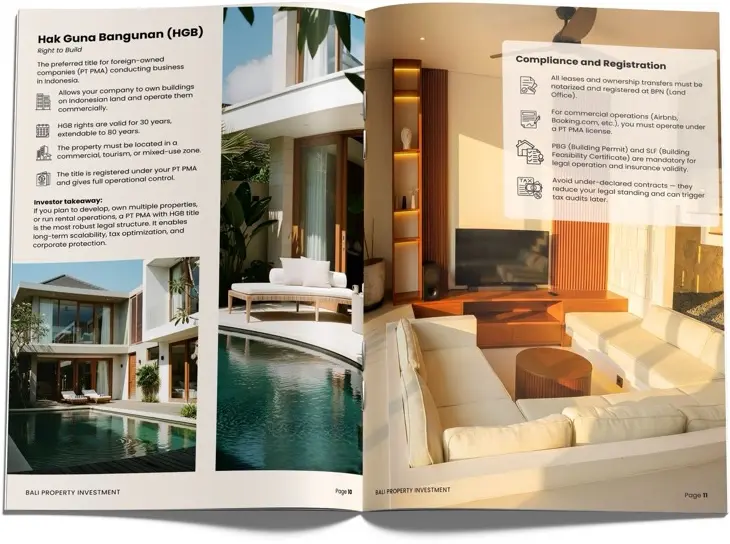



Australians can legally invest in Bali property, but not as freehold. The three compliant routes are a leasehold (Hak Sewa), a Hak Pakai right-to-use title, or a foreign-owned PT PMA company holding Hak Guna Bangunan. Nominee arrangements, common but illegal, are the one path to avoid.
Last updated: 10 July 2026
Key facts at a glance
- Freehold (Hak Milik) is closed to every foreigner under Indonesia's 1960 Basic Agrarian Law. Australians included.
- Three legal routes: leasehold (typically 25-30 years), Hak Pakai, or a PT PMA company holding HGB (up to 80 years).
- Budget 8-12% of the price for transaction costs: BPHTB 5%, notary, due diligence and PT PMA setup where used.
- Indonesian rental income is assessable in Australia. A foreign income tax offset removes most, not always all, double tax.
- Realistic Canggu net yields run about 7-11%, not the 15%+ often advertised.
Australians are one of the largest groups of foreign buyers in Bali, and one of the most exposed to bad advice. The island sits four to six hours from the east coast, the lifestyle is familiar, and the yields on paper look nothing like a Sydney or Melbourne rental. The gap between a good outcome and a costly one is almost never the property. It is the structure, the tax planning and the diligence behind it. This guide walks an Australian buyer through what you can legally own, what it costs, how Australian tax treats it, and how our clients complete the whole purchase without leaving home.

Can Australians legally buy property in Bali?
Yes, Australians can legally buy and hold property in Bali, but never as outright freehold. Indonesian law reserves Hak Milik (freehold) for Indonesian citizens, so an Australian invests through one of three legal instruments: a leasehold, a Hak Pakai right-to-use title, or a foreign-owned PT PMA company. Each is compliant. The one to avoid is a nominee.

The rule comes from the 1960 Basic Agrarian Law, which prohibits foreigners from holding freehold and prohibits indirect ownership through an Indonesian proxy. That second point matters. A "nominee" structure, where a local citizen holds the freehold title on your behalf under a side agreement, is technically unenforceable and illegal. If the nominee sells, dies or simply refuses to cooperate, the foreign investor has no title to defend. It is the single most common way Australians lose money in Bali, and it is entirely avoidable by using one of the legal routes below.
For a deeper look at the legal instruments themselves, see our guide on whether foreigners can own land in Bali. Investland has never placed a client into a nominee structure. Across 120+ foreign investors since 2022, every purchase has sat on a leasehold, Hak Pakai or PT PMA foundation, by design.
The three ownership structures Australians use
Australians typically choose between three structures: leasehold for the lowest entry and simplest exit, Hak Pakai for personal-use ownership when you hold Indonesian residency, and a PT PMA company when you want the most secure long-term control and the ability to run the villa as a business. The right one depends on your budget, your timeline and whether the property is for income, use, or both.

| Structure | What you actually hold | Typical term | Residency needed? | Best for |
|---|---|---|---|---|
| Leasehold (Hak Sewa) | A registered right to use the land and villa for a fixed period | 25-30 years, often extendable | No | Lower entry cost, holiday use, shorter horizon |
| Hak Pakai (Right to Use) | A right-to-use title registered in your name | Initial 30 years, renewable toward 80 | Yes (KITAS/KITAP) | Residents buying for personal use |
| PT PMA + HGB | Shares in a foreign-owned Indonesian company that holds Hak Guna Bangunan (right to build) | HGB up to 80 years | No (company holds title) | Rental businesses, portfolios, maximum control |
A PT PMA (Penanaman Modal Asing) is a fully foreign-owned Indonesian company. It can hold building title, sign leases, employ staff and legally run a rental business, which a leasehold in your personal name cannot. It also carries real obligations: an investment plan of IDR 10 billion per business line (about USD 600,000, roughly AUD 860,000) excluding land and buildings, and a paid-up capital of IDR 2.5 billion (about USD 150,000) under the Minister of Investment Regulation No. 5 of 2025 that took effect in October 2025. Setup runs 4-6 weeks through the OSS system. Investland has established 60+ PT PMA companies, so the paid-up capital, KBLI business codes and reporting are handled as a known process rather than a surprise. If you plan to rent the villa, read our companion guide on structuring a Bali villa rental business with a PT PMA.
What it costs to buy: budget 8 to 12%
Beyond the sticker price, an Australian buyer should budget 8-12% of the purchase value for transaction costs. The largest single line is BPHTB, the 5% acquisition tax on the assessed value, which must be paid before the deed can transfer. Notary and PPAT fees, legal due diligence, and PT PMA setup where relevant make up the rest. These are real, non-negotiable stages, not optional extras.

| Cost | Typical rate | On a USD 300,000 villa (~AUD 430,000) | Who it goes to |
|---|---|---|---|
| BPHTB acquisition tax | 5% of assessed value | ~USD 15,000 | Indonesian government |
| Notary / PPAT | 1-2.5% (negotiable) | ~USD 3,000-7,500 | Land deed official |
| Legal due diligence | Fixed fee | ~USD 1,000-2,500 | Lawyer / advisor |
| PT PMA setup (if used) | Fixed fee + capital | ~USD 2,500-4,000 in fees | Corporate / OSS |
| Agent / advisory | Varies | Often paid by seller | Agent |
Figures are indicative and vary by property, zone and structure. The point Australians miss is that these costs buy something: title verification, zoning and permit checks (PBG/SLF), and a clean transfer. Skipping them to save a few thousand dollars is how buyers inherit an unpermitted building or a disputed title. For the full line-by-line breakdown, see our Bali property buying costs guide.
Want the numbers for your exact budget and structure? Download our Bali Investment Guide, or book a free call with Kristjan to map the costs for your situation.
Financing and sending money from Australia
Bali property is almost always bought in cash, because Indonesian banks rarely lend to foreigners and Australian lenders will not mortgage an offshore villa. Most Australians fund the purchase from savings, an offset redraw, or by releasing equity against an Australian property, then transfer the funds in staged payments. Currency and reporting, not credit approval, are the real planning points.

Two practical realities. First, foreign exchange moves your real cost: at the current rate around 1 AUD to 0.69 USD, a USD 300,000 villa is roughly AUD 430,000, and a 3% swing in the rate is over AUD 12,000 on the same purchase. A specialist FX provider will usually beat a bank's retail rate meaningfully. Second, large transfers are reported: outbound international transfers are captured by AUSTRAC, and Indonesian banks apply their own source-of-funds checks, so keep clean records of where the money came from. Our guide on sending money from Australia to Bali covers timing and FX in detail. For off-plan purchases, funds are released against construction milestones rather than paid up front, which protects your capital during the build.
Australian tax on a Bali property
Owning a Bali property does not take you outside the Australian tax net. As an Australian tax resident, your worldwide income is assessable, so Indonesian rental income must be declared to the ATO in the year it is earned, and a capital gain on sale is generally taxable in Australia. Tax paid in Indonesia is credited back through the foreign income tax offset, which prevents most double taxation.

| Tax touchpoint | How the ATO treats it |
|---|---|
| Rental income | Assessable in Australia when earned; Indonesian tax paid is credited via the foreign income tax offset |
| Capital gains on sale | Taxable; the main residence exemption does not apply to an overseas villa. A 50% CGT discount generally applies to individuals holding more than 12 months |
| Proposed CGT change | The government has proposed replacing the 50% discount with cost-base indexation and a 30% minimum rate from 1 July 2027. Not yet law |
| SMSF ownership | Very restricted. Sole-purpose, in-house-asset and related-party rules make direct Bali property hard to hold compliantly in a self-managed super fund |
| Currency conversion | The ATO requires each figure converted to AUD at the rate on the date of the transaction |
The SMSF question comes up constantly and the honest answer is "rarely, and only with specialist advice." We cover it in full in our SMSF and Bali property guide, and the reporting and CGT detail in our Australian tax on Bali property guide. Verify your own position with the ATO guidance on foreign residents and CGT and a registered Australian accountant. Investland is not a tax adviser; we structure the Indonesian side correctly so your Australian accountant has clean numbers to work with.
What Australians actually earn: real Canggu yields
Realistic net yields on a well-bought, well-managed Canggu villa run about 7-11%, not the 12-15% gross figures splashed across listings. Gross is before management, tax, maintenance, vacancy and platform fees. Net is what reaches your account. A 2-bedroom bought at a fair price and actively managed sits at the upper end; an overpriced or poorly run villa can fall to 3-6% despite the glossy projection.
| Scenario | Realistic net yield | Notes |
|---|---|---|
| 2BR bought well, actively managed (Pererenan/Canggu) | 9-11% | Off-plan entry, strong design, professional management |
| Core Canggu at market price, well managed | 7-10% | Solid, sustainable, defensible |
| Overpriced or poorly managed | 3-6% | Despite advertised 12-15% gross |
Investland publishes delivered numbers rather than promises: net yields from 10% on correctly structured projects, and 20-25% capital appreciation during the construction phase on our delivered developments, managed through our sister brand Pellago and built by Constructland. Returns are not guaranteed and depend on market conditions, property type and management. For a worked example with real figures, see our 2BR Amari villa ROI case study, and our Canggu neighbourhood guide for area-by-area entry points.
How to buy from Australia, remotely and safely
You do not need to fly to Bali to buy safely. Most of Investland's Australian clients complete the entire purchase remotely, using a defined process where diligence, contracts and payments happen in stages with a team on the ground acting on verified instructions. The point is not convenience for its own sake; it is that every step is documented and checked before money moves.

- Strategy call and plan. Define budget, timeline, income vs use, and the right structure before looking at any villa.
- Shortlist and verify. We check title, zoning, permits (PBG/SLF) and the developer's track record on each candidate.
- Structure setup. Establish the leasehold, Hak Pakai or PT PMA, with the paid-up capital and KBLI codes correct from day one.
- Contracts and notary. Review the AJB or lease deed with an independent notary; sign remotely via power of attorney where needed.
- Staged payment. Funds released against milestones (for off-plan) or on clean transfer, with BPHTB settled before the deed.
- Handover and management. Snagging and QA at handover, then rental management so the asset performs without your daily involvement.
If residency is part of your plan, a property investment can also support a longer stay. See our guide to the Indonesia Golden Visa and residency through property.
Thinking about investing in Bali? Talk to Kristjan.
Book a free, no-pressure call. We will map the legal structure, numbers and options for your situation.
Book a call with KristjanFrequently asked questions
Can Australians own freehold land in Bali?
No. Freehold (Hak Milik) is reserved for Indonesian citizens under the 1960 Basic Agrarian Law. Australians invest through leasehold, a Hak Pakai right-to-use title, or a foreign-owned PT PMA company that holds building rights. All three are legal and secure when set up correctly.
Is a nominee arrangement safe for Australian buyers?
No. A nominee, where an Indonesian holds freehold title on your behalf, is illegal and unenforceable under Indonesian law. You have no defensible title if the nominee sells, dies or disputes the arrangement. Every legitimate structure avoids nominees entirely, which is why Investland never uses them.
Do I pay Australian tax on Bali rental income?
Yes. As an Australian tax resident you declare Indonesian rental income to the ATO in the year it is earned. Indonesian tax paid is credited back through the foreign income tax offset, which prevents most double taxation. Confirm your position with a registered Australian accountant.
How much money do I need to buy in Bali?
Entry-level leasehold villas start around USD 150,000 to 250,000, with quality 2-bedroom investment villas commonly USD 250,000 to 400,000. Add 8-12% for transaction costs. A PT PMA route carries its own paid-up capital of about USD 150,000 that stays inside your company.
Can I buy a Bali property without flying there?
Yes. Most of our Australian clients complete the purchase remotely, using staged diligence, an independent notary and power of attorney for signing. Payments are released against verified milestones, so your capital is protected at every step without you being on the island.
Can I hold a Bali property in my SMSF?
Rarely, and only with specialist advice. Superannuation rules on sole purpose, in-house assets and related parties make direct offshore property difficult to hold compliantly. Most Australians buy in their personal name or through a PT PMA. Speak to an SMSF specialist before assuming it is possible.
Written by Kristjan Ploompuu, co-founder of Investland Bali. Kristjan has guided 120+ foreign investors into legally structured Bali property since 2022 and has overseen 60+ PT PMA company setups. He specialises in investment strategy, legal structuring and the compliance realities most agents skip.
Published 10 July 2026. Last updated 10 July 2026.
This article is general information, not legal, tax or financial advice. Returns are not guaranteed and depend on market conditions, property type and management. Verify your tax position with a registered Australian accountant.