
Canggu Real Estate 2026: Prices, Yields & Areas

Key takeaway: Canggu real estate in 2026 means leasehold villa prices from around $100,000 for a one-bedroom to $400,000+ for a premium three-bedroom, with net rental yields of 8 to 12% for professionally managed properties. But these headline numbers hide significant variation between sub-areas. A two-bedroom villa in Berawa and a two-bedroom villa in Cemagi operate in different markets with different guest profiles, different occupancy patterns, and different risk profiles. This guide breaks Canggu down sub-area by sub-area so investors can compare prices, yields, and trade-offs before committing capital.
Canggu is Bali's most active property investment market. It accounts for roughly a third of all foreign investor transactions on the island, more than any other single area. The reasons are straightforward: deep demand from digital nomads, surf tourists, young families, and short-stay holiday guests creates year-round rental income that few other Bali locations can match.
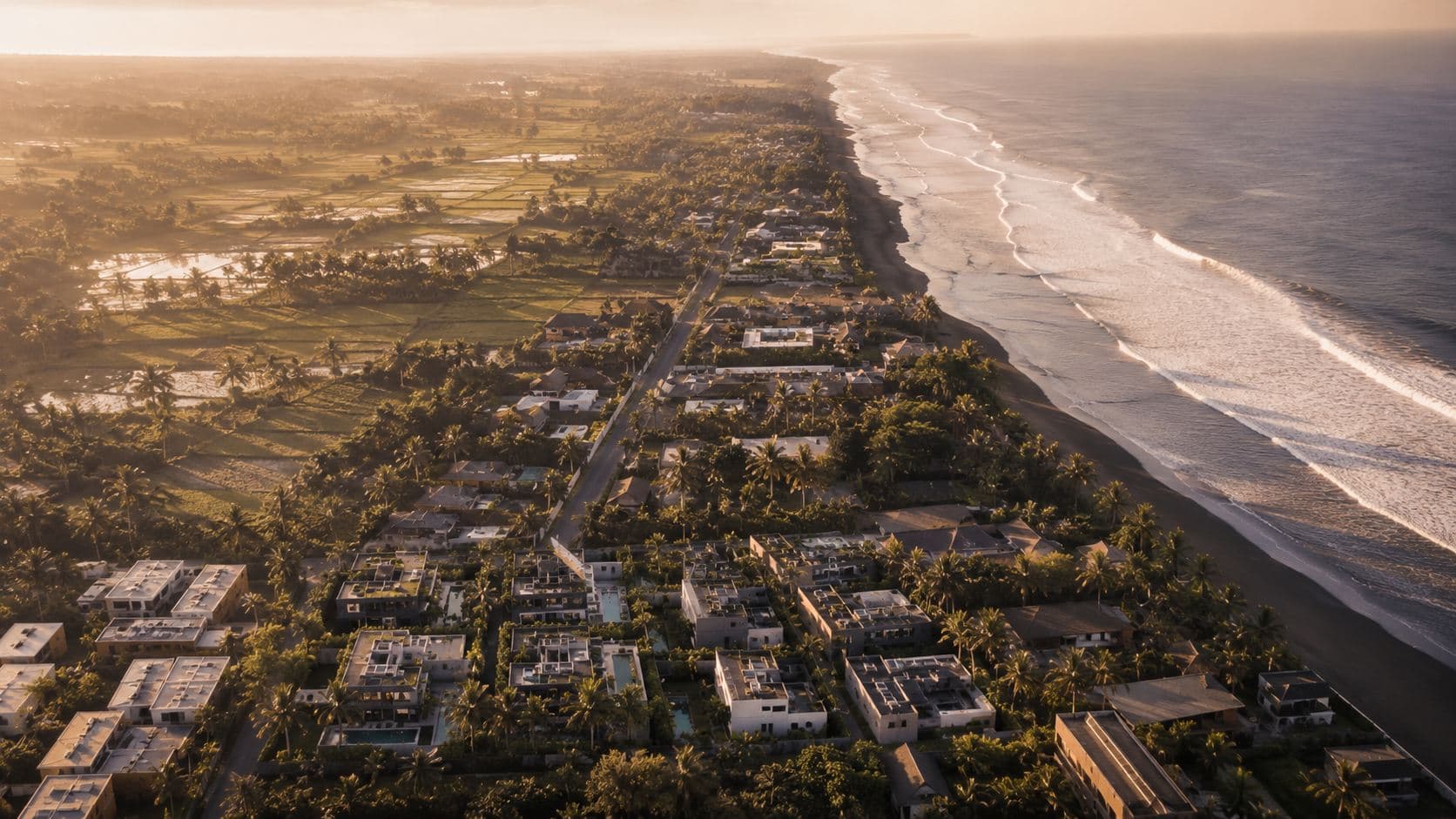
But "Canggu" is not one market. It is a corridor stretching from Berawa in the south to Cemagi in the north, roughly 8 kilometres of coastline covering at least eight distinct sub-areas. Each has its own pricing, its own guest profile, and its own trajectory. Treating them as interchangeable is the first mistake investors make.
This article maps each sub-area with current pricing, rental performance, and infrastructure developments. It also covers the zoning reality that most Canggu investment guides leave out -- a factor that will reshape the competitive landscape over the next 12 to 24 months.
For Bali-wide area comparisons, see Best Areas to Invest in Bali 2026. For rental income data across all of Bali, see Bali Airbnb Income 2026.
Canggu Real Estate by the Numbers

Before diving into sub-areas, it helps to understand the macro picture. Canggu's market fundamentals have shifted over the past three years from a growth-phase market to a mature one.
Canggu Market Overview 2026
| Metric | Figure | Source |
|---|---|---|
| Active Airbnb listings | ~4,000 | AirROI Canggu market data |
| Average daily rate (ADR) | $214 | AirROI 2026 |
| Professionally managed villa occupancy | 70 to 85% | Operational data from managed portfolios |
| Leasehold villa price (1-bed) | $100,000 to $180,000 | Transaction data 2024-2026 |
| Leasehold villa price (2-bed) | $120,000 to $250,000 | Transaction data 2024-2026 |
| Leasehold villa price (3-bed) | $170,000 to $400,000 | Transaction data 2024-2026 |
| Net rental yield | 8 to 12% | Calculated from managed portfolio income vs acquisition cost |
| 3-year property appreciation | 8 to 15% annually | Market surveys, BPS Bali |
The occupancy figure of 70 to 85% in this table refers specifically to professionally managed, well-located villas. It does not reflect the platform-wide average, which sits much lower once you factor in studio apartments, part-time listings, unlicensed properties with poor reviews, and units that owners block for personal use. The difference is significant, and it is the entire Canggu investment thesis: properties that are well-designed, correctly zoned, professionally managed, and competitively priced dramatically outperform the market average. Properties that are generic, poorly located, or operationally neglected earn far less.
Area-by-Area Breakdown

The Canggu corridor includes eight investable sub-areas. Each occupies a different position on the price-demand spectrum.
Canggu Sub-Area Comparison
| Sub-area | 1-bed villa (LH) | 2-bed villa (LH) | 3-bed villa (LH) | ADR range | Managed occupancy | Guest profile |
|---|---|---|---|---|---|---|
| Berawa | $130,000 to $180,000 | $180,000 to $250,000 | $280,000 to $400,000 | $200 to $280 | 75 to 85% | Families, upscale nomads, beach club visitors |
| Batu Bolong | $120,000 to $170,000 | $170,000 to $240,000 | $250,000 to $350,000 | $180 to $250 | 72 to 82% | Surfers, young couples, backpacker-to-boutique |
| Echo Beach | $110,000 to $160,000 | $150,000 to $220,000 | $220,000 to $320,000 | $170 to $240 | 68 to 78% | Surf tourists, sunset seekers, mid-range travelers |
| Babakan | $100,000 to $150,000 | $140,000 to $210,000 | $200,000 to $300,000 | $150 to $220 | 65 to 78% | Nomads, young couples, mid-term stays |
| Umalas | $100,000 to $150,000 | $140,000 to $200,000 | $200,000 to $300,000 | $150 to $220 | 65 to 78% | Families, long-stay nomads, school proximity |
| Pererenan/Seseh | $100,000 to $140,000 | $130,000 to $200,000 | $180,000 to $280,000 | $160 to $230 | 65 to 80% | Wellness travelers, yoga retreats, monthly nomads |
| Padonan | $100,000 to $130,000 | $120,000 to $180,000 | $170,000 to $260,000 | $130 to $190 | 58 to 72% | Budget nomads, long-stay guests, early adopters |
| Cemagi | $100,000 to $125,000 | $120,000 to $175,000 | $160,000 to $240,000 | $140 to $200 | 58 to 72% | Budget-conscious travelers, long-stay guests |
These ranges reflect professionally operated villas with pools, modern design, and active listing management. Self-managed properties or those with dated interiors typically earn 20 to 30% less in both ADR and occupancy.
Berawa: The Established Core

Berawa is Canggu's most expensive and most liquid sub-area. It sits closest to Seminyak and benefits from the highest concentration of restaurants, beach clubs (Finns Beach Club, La Brisa), international schools (Canggu Community School), and coworking spaces.
For investors, Berawa offers the lowest risk in Canggu. Demand is deep and diversified. A two-bedroom villa in Berawa priced at $200,000 to $250,000 on a 25-year lease can generate $18,000 to $28,000 in net annual rental income at 75 to 85% occupancy. One-bedroom villas start from around $130,000 and suit investors entering the market with less capital. The guest mix -- families during school holidays, digital nomads on monthly stays, couples on short breaks -- protects occupancy across seasons.
The trade-off is entry price. Berawa is the most expensive sub-area in the Canggu corridor, second only to Seminyak on the island. Yield percentages are compressed compared to emerging areas. An investor spending $250,000 in Berawa and earning $25,000 net gets a 10% yield. The same capital in Pererenan might acquire a comparable villa for $180,000 and earn $20,000 net -- an 11% yield with lower capital at risk.
Berawa is the right choice for investors who prioritise liquidity and predictability over yield maximisation. Properties here sell faster on the secondary market than in any other Canggu sub-area.
Batu Bolong and Echo Beach: The Surf Corridor

Batu Bolong and Echo Beach form Canggu's original identity. The surf breaks at Batu Bolong and Echo Beach draw a consistent stream of travelers year-round, and the strip between them is lined with cafes, board rental shops, and boutique hotels.
The guest profile skews younger (25 to 40) and more price-sensitive than Berawa. Average daily rates are $170 to $250 depending on property quality. Occupancy runs 68 to 82% for managed properties. The volume of competing listings is highest in this corridor, which means property differentiation matters more here than anywhere else in Canggu.
Investors in this area should note the supply density. With roughly 1,500 active Airbnb listings concentrated between Batu Bolong and Echo Beach, standing out requires either premium design, a unique amenity (rooftop bar, dedicated workspace, private gym), or consistently strong reviews. Generic two-bedroom villas with standard pools face the most occupancy pressure on the island.
Villa entry points sit between $110,000 for a one-bedroom and $350,000 for a premium three-bedroom leasehold. Two-bedroom villas -- the most common investment format -- run $150,000 to $240,000. The lower end of that range buys properties on secondary roads, 10 to 15 minutes walk from the beach. Premium beachside access pushes prices toward the upper range.
Pererenan and Seseh: The Value Play

Pererenan sits directly north of Batu Bolong. Three years ago it was a quiet residential area with rice fields and local warungs. Today it has its own cafe scene, yoga studios, and a growing number of boutique developments, but villa prices remain 20 to 30% below equivalent Berawa properties.
The investment thesis for Pererenan is the same one that made Canggu attractive five years ago: proximity to established demand at lower entry prices. A three-bedroom villa in Pererenan can be acquired for $180,000 to $250,000, roughly $50,000 to $80,000 less than a comparable property in Berawa.
Guest demand is real but narrower. Pererenan attracts wellness travelers, yoga retreat groups, and digital nomads on monthly stays. Short-stay holiday guests still search for "Canggu" on booking platforms rather than "Pererenan," which means listings need to be positioned carefully with location descriptions that reference the Canggu corridor.
Seseh and Cemagi extend further north. These areas offer the lowest entry prices in the broader Canggu market -- one-bedroom villas from $100,000, two-bedrooms from $120,000 -- but brand recognition is limited. Occupancy rates for managed properties in Cemagi run 58 to 72%, meaningfully below the Berawa and Batu Bolong corridor. The gap reflects both distance from core attractions and lower search volume on booking platforms.
For investors with a 3 to 5 year horizon and tolerance for lower initial occupancy, these northern sub-areas represent the steepest growth curve. The proposed Bali Metro Phase 1 route runs through the Cemagi corridor, which could compress the access disadvantage significantly if it proceeds on schedule.
Babakan: The Transitional Middle Ground
Babakan sits between central Canggu and the Kerobokan-Umalas corridor. It is more residential than Batu Bolong or Echo Beach, but better connected to Canggu's core commercial strip than Umalas. Riders can reach Batu Bolong beach in 5 to 8 minutes by scooter and Seminyak in 10 to 15 minutes.
The area has developed quickly since 2023, driven by a growing number of cafes, co-working spaces, and boutique villa developments along Jalan Babakan and its side roads. The feel is quieter than the surf corridor but more active than Umalas -- a middle ground that appeals to digital nomads on mid-term stays and young couples who want proximity to the action without the density.
One-bedroom villas in Babakan start from around $100,000 on a 25-year lease. Two-bedrooms run $140,000 to $210,000, and three-bedrooms $200,000 to $300,000. Average daily rates sit at $150 to $220, with managed occupancy of 65 to 78%. The guest profile leans toward stays of one to three months rather than nightly turnover, which translates to lower management overhead.
Babakan is worth considering for investors who want Canggu convenience at Umalas-level pricing. The main risk is supply growth: several new villa developments are in the pipeline, and the sub-area's appeal depends partly on retaining the quieter character that distinguishes it from the surf corridor.
Umalas: The Quiet Alternative
Umalas is technically east of central Canggu, inland rather than coastal. It appeals to a different buyer: families prioritising school proximity, long-stay nomads who want residential quiet within a 10-minute scooter ride of Canggu's beaches and cafes, and investors targeting the growing long-term rental segment.
Villa prices in Umalas sit between Pererenan and Batu Bolong. One-bedroom leaseholds start from $100,000, two-bedrooms range from $140,000 to $200,000, and three-bedrooms from $200,000 to $300,000. The guest profile leans toward longer stays, which means lower turnover costs and more predictable income, but also lower nightly rates ($150 to $220 ADR).
Umalas is underrepresented on most Canggu investment guides, partly because it lacks the beachfront appeal that drives Airbnb search traffic. But that gap between perception and reality is exactly the opportunity. Monthly rental demand from families enrolled at nearby international schools creates predictable year-round income without the seasonal volatility that affects coastal sub-areas. A two-bedroom villa in Umalas rented at $1,500 to $2,200 per month on a 12-month lease produces $18,000 to $26,400 annually with near-zero vacancy and minimal management overhead.
For investors focused on long-term rental income rather than short-term holiday rental, Umalas offers a quieter alternative with lower operational complexity and a tenant profile that renews rather than turns over every three nights.
Padonan: The Next Frontier
Padonan sits between Pererenan and Cemagi, slightly inland from the coastal road. It is one of the last areas in the broader Canggu corridor where rice field views are still common and villa density is low. For investors who missed the early pricing in Pererenan three years ago, Padonan occupies a similar position today.
One-bedroom villas start from $100,000, two-bedrooms from $120,000 to $180,000, and three-bedrooms from $170,000 to $260,000. These are the lowest non-Cemagi prices in the corridor. Average daily rates run $130 to $190, and managed occupancy sits at 58 to 72% -- comparable to Cemagi but with slightly better access to the Pererenan cafe and wellness scene.
The guest profile is dominated by budget-conscious digital nomads and long-stay guests booking one to six months. Short-stay demand exists but depends heavily on listing positioning -- guests searching for "Canggu" or "Pererenan" on Airbnb need to see the property in those search results to consider it.
Padonan's upside case is infrastructure-driven. The area sits along the proposed Bali Metro Phase 1 corridor, and the West Bali Toll Road alignment would improve access significantly. Neither project is guaranteed, but both would close the gap between Padonan and established sub-areas. The downside risk is that without those catalysts, brand recognition remains weak and occupancy stays in the 60s.
The Zoning Problem Most Guides Ignore

This is where the Canggu investment story gets complicated. According to analysis of Bali's RDTR (Digital Spatial Plan), roughly 80% of villas in Canggu sit on land zoned for residential or agricultural use, not for commercial tourism accommodation. Operating a short-term rental on non-tourism-zoned land requires a Pondok Wisata (homestay) license, which itself requires the property to be in an eligible zone.
Since 2025, the RDTR system is directly integrated with Indonesia's OSS (Online Single Submission) licensing platform. When a property owner applies for a business license, the system automatically checks the property's location against the zoning map. Properties on non-tourism-zoned land cannot obtain the licenses required to legally operate on platforms like Airbnb and Booking.com.
The March 31, 2026 compliance deadline required all accommodation properties listed on online travel platforms to hold a valid Indonesian business license. Enforcement is being phased in gradually rather than through mass delisting, but the regulatory direction is clear: unlicensed properties face increasing operational risk as platform compliance mechanisms tighten through 2026 and into 2027.
What this means for investors:
Zoning verification is non-negotiable. Before committing to any Canggu property purchase, verify the exact zoning classification using the RDTR online map. Properties in pink (tourism) zones can obtain the required licenses. Properties in green (agricultural) or yellow (residential) zones face a harder path to legal short-term rental operations.
Supply reduction creates opportunity. If enforcement proceeds, a meaningful portion of Canggu's 4,000+ Airbnb listings could be forced offline. For properties that are correctly zoned and fully licensed, this would reduce competition and potentially increase both occupancy and ADR.
Premium for compliant properties is emerging. Buyers are increasingly willing to pay 10 to 15% more for properties with verified tourism zoning, existing Pondok Wisata licenses, and complete building permits (PBG). This premium will likely increase as enforcement tightens.
For a deeper look at Bali's zoning system, see Bali Land Zones Explained. For due diligence procedures, see Due Diligence Bali Property: The 2026 Checklist.
Infrastructure That Will Reshape Canggu
Two infrastructure projects are directly relevant to Canggu property values.
Bali Metro Phase 1. The planned urban rail line connects Ngurah Rai Airport to the Canggu corridor, with stations proposed at Kuta, Seminyak, Berawa, and Cemagi. The project was formally launched in September 2024 and is part of Indonesia's National Strategic Infrastructure plan, but progress has been slow. The consortium appointed to lead the project (PT Bumi Indah Prima) has faced legal disputes and construction has not meaningfully advanced. The target completion window is 2028 to 2030, but delays are likely.
If completed, the Metro would cut airport-to-Canggu transit from 90+ minutes in traffic to approximately 25 to 30 minutes. The impact on property values would be significant, particularly for properties near planned station locations. Berawa and Cemagi stand to benefit most.
Investors should treat the Metro as a potential upside, not a guaranteed catalyst. Price your investment based on current access conditions and treat the rail connection as a bonus if it materialises.
West Bali Toll Road. The proposed 96.84-kilometre toll road connecting western Bali to the central south would pass through the greater Canggu-Pererenan corridor. The project is classified as a National Strategic Project but is currently in re-tender after 2025 delays. If built, it would significantly improve access to northern Canggu sub-areas and could accelerate development in Seseh and Cemagi.
For the full infrastructure analysis, see Indonesia Mega-Projects 2026: Impact on Bali Property Values.
Who Should Invest in Canggu (and Who Shouldn't)

Canggu is the right market for investors who want proven rental demand, deep liquidity, and the ability to exit relatively quickly on the secondary market. It suits portfolio investors seeking predictable cash flow, lifestyle buyers who want personal use during low season and rental income during peaks, and first-time Bali investors who value the security of an established market.
Canggu is the wrong market for investors seeking the highest possible yield percentage. Uluwatu offers 10 to 15% net yields at lower entry prices. Pererenan offers Canggu-adjacent demand at lower entry costs. Ubud operates on entirely different dynamics better suited to wellness and long-stay models. Investors purely seeking capital appreciation may find better upside in emerging areas where the growth curve is steeper.
The right question is not whether Canggu is a good investment. It is which Canggu sub-area matches your capital, risk tolerance, and return expectations. Berawa for safety. Batu Bolong for surf-driven demand. Babakan for convenience at lower prices. Umalas for quiet. Pererenan for value. Padonan for early-stage upside. Cemagi for frontier pricing. Each serves a different strategy.
For Bali-wide area comparison data, see Best Areas to Invest in Bali 2026. For rental yield calculations, see Bali Rental Yield 2026. For the legal framework, see How to Buy Property in Bali as a Foreigner.
Frequently Asked Questions
Is Canggu still a good investment in 2026?
Canggu remains Bali's most liquid property market with the deepest rental demand pool. Professionally managed villas achieve 70 to 85% occupancy and 8 to 12% net yields. However, the market has matured. Generic properties face occupancy pressure from 4,000+ competing Airbnb listings, so property quality, design, and management matter more than in earlier growth phases. Correctly zoned and licensed properties are positioned to benefit from upcoming regulatory enforcement that could reduce unlicensed supply.
How much does a villa cost in Canggu?
A one-bedroom leasehold villa in Canggu starts from $80,000 in emerging areas like Cemagi and Padonan, rising to $180,000 in Berawa. Two-bedrooms cost $120,000 to $250,000 depending on sub-area. Three-bedroom villas range from $170,000 to $400,000. These are 25 to 30 year leasehold figures. Freehold-equivalent prices through PT PMA structures are 30 to 50% higher.
What is the best sub-area in Canggu for rental income?
Berawa generates the highest absolute rental income due to premium ADR ($200 to $280/night) and the strongest occupancy (75 to 85%). Pererenan offers the best yield percentage because lower acquisition costs ($130,000 to $200,000 for a 2-bed) produce higher returns relative to capital invested. Batu Bolong sits between the two with strong surf-driven demand but higher supply competition. The best choice depends on whether you optimise for total income or yield percentage.
How many Airbnb listings are in Canggu?
Canggu has approximately 4,000 active Airbnb listings as of 2026, making it the most densely supplied short-term rental market in Bali. However, a significant portion of these listings operate on land not zoned for tourism accommodation. The March 2026 compliance deadline requiring valid business licenses for all platform-listed properties could meaningfully reduce effective supply, benefiting correctly zoned and licensed properties.
What is the zoning risk in Canggu?
Approximately 80% of Canggu villas sit on land zoned for residential or agricultural use rather than tourism (pink zone). Since 2025, Indonesia's RDTR zoning system is integrated with the OSS licensing platform, making it impossible to obtain tourism business licenses for properties on non-tourism-zoned land. Investors should verify zoning classification on the RDTR online map before purchasing and factor licensing feasibility into their due diligence process.
Will the Bali Metro affect Canggu property values?
The planned Bali Metro Phase 1 connects Ngurah Rai Airport to the Canggu corridor (Berawa to Cemagi). If completed, it would reduce airport transit from 90+ minutes to approximately 25 to 30 minutes, likely increasing property values near station locations. However, progress has been slow since the September 2024 groundbreaking, and the project faces legal disputes with the lead consortium. Investors should treat the Metro as potential upside rather than a priced-in certainty. Target completion is 2028 to 2030 with likely delays.
How does Canggu compare to Uluwatu for investment?
Canggu offers higher liquidity, deeper demand, and more predictable cash flow. Uluwatu offers higher yields (10 to 15% net) and stronger capital appreciation at lower entry prices. Canggu suits investors who prioritise proven demand and exit flexibility. Uluwatu suits investors who prioritise growth and are comfortable with less developed infrastructure and smaller secondary markets. Both are strong choices -- the question is which risk-return profile fits your strategy. For detailed comparison, see Best Areas to Invest in Bali 2026.