
How to Buy Property in Bali as a Foreigner


How to buy property in Bali as a foreigner?
Indonesian law does not allow foreign nationals to hold freehold land (Hak Milik) directly. But three legal structures give international investors full access to the Bali property market:
Leasehold (Hak Sewa) for fixed-term agreements of 25 to 30 years, Right to Use (Hak Pakai) for individual residential ownership with a valid stay permit, and PT PMA with HGB Title (a foreign-owned Indonesian company) for the strongest legal standing, business rights, and long-term asset control.
The entire process, from legal setup to property acquisition, takes 4 to 12 weeks depending on the structure you choose.
Can Foreigners Buy Property in Bali?
The short answer: yes. The longer answer requires understanding how Indonesian property law works, because it operates differently from most Western markets.
Under Indonesia's Basic Agrarian Law (Law No. 5/1960), only Indonesian citizens can hold freehold land title (Hak Milik). This is a constitutional restriction that has been in place since independence and is not changing.
But that does not mean the door is closed. Indonesian law provides multiple legal pathways for international investors to acquire, develop, and profit from Bali real estate. The three main structures are leasehold agreements, Right to Use (Hak Pakai) titles, and foreign-owned companies (PT PMA) that hold property under Right to Build (Hak Guna Bangunan) or Right to Use titles.
Each structure suits a different type of buyer. The right choice depends on your investment horizon, budget, and whether you plan to run a rental business. We will break down each one in detail.
One important note before we start. You may hear about "nominee arrangements" where an Indonesian citizen holds freehold title on your behalf. This practice is illegal under Indonesian law, legally unenforceable, and puts your entire investment at risk. An estimated 10,500 properties in Bali are held through nominee structures, representing approximately $10.4 billion in at-risk assets. The Indonesian government has signalled increasing enforcement. Do not go this route.
If you want to get to know the market in and out, download our Full Investment Guide here!

The Three Legal Ways to Buy Property in Bali as a Foreigner
1. Leasehold (Hak Sewa)
Leasehold is the simplest and most common structure for international buyers in Bali. You sign a lease agreement with the landowner (who holds freehold title) for a fixed period, typically 25 to 30 years, with options to extend.
How it works: You negotiate a lease term and price directly with the landowner. The agreement is notarised and registered. You get exclusive rights to use, develop, and sublease the property for the duration of the lease.
Best for: Lifestyle buyers, medium-term investors, and anyone who wants a straightforward entry into the Bali market without corporate setup costs.
Key details:
- Typical terms: 25 to 30 years with extension options (often structured as 25+25 or 30+20)
- No corporate setup required
- No minimum investment threshold
- No residency permit needed
- Lower entry cost than PT PMA
- You can sublease the property and earn rental income
- Tax: the lessor pays 10% of the declared lease value. As the lessee, you are typically tax exempt on the acquisition itself
What to watch: Extension clauses are critical. Make sure the lease agreement includes clear language about renewal terms, pricing, and the process for exercising the extension. Have a qualified notary draft or review these clauses. A poorly worded extension clause is one of the most common mistakes foreign buyers make in Bali.
2. Right to Use (Hak Pakai)
Hak Pakai grants a foreigner the legal right to own and occupy an individual house built on land designated with a Right to Use title. This is the closest thing to personal property ownership available to a foreign individual in Indonesia.
How it works: You purchase a property with a Hak Pakai certificate. The title is registered in your name at the local land office (BPN). You hold the right for 30 years initially. Extensions add 20 years. A final renewal grants another 30 years. That gives you up to 80 years of legal use.
Best for: Individuals who want personal residential ownership in their own name, not through a company.
Key details:
- Initial term: 30 years, extendable to 80 years total (30+20+30)
- Title registered in your personal name
- Requires a valid Indonesian stay permit (KITAS or KITAP)
- Limited to residential use (one property per person)
- Buyer's tax: 5% of declared value
- Seller pays 2.5% tax
- Notary fee: approximately 1% of transaction value (negotiable for larger transactions)
- When sold to an Indonesian citizen, Hak Pakai converts to freehold (Hak Milik). This means you capture capital appreciation at parity with freehold values
What to watch: You need an active KITAS or KITAP to acquire Hak Pakai title. If your permit expires and is not renewed, your rights may be affected. Plan your residency status before pursuing this route.
3. HGB with a PT PMA (Foreign-Owned Indonesian Company)
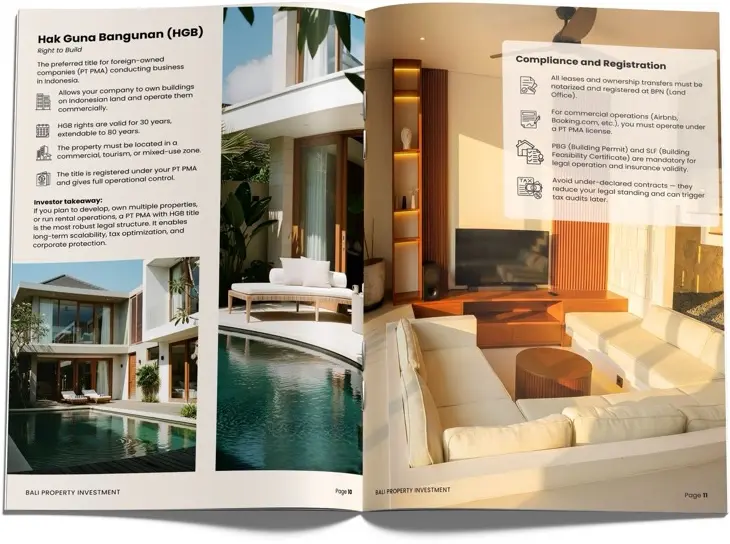
A PT PMA is a Perseroan Terbatas Penanaman Modal Asing, an Indonesian limited liability company with foreign ownership. This is the most robust legal structure for serious property investors and anyone who plans to run a rental or hospitality business.
How it works: You establish a PT PMA. The company holds property under Right to Build (HGB) title. You own the company. The company owns the property. This gives you legal control of the asset, the ability to operate a business, and the strongest position for long-term investment.
Best for: Portfolio investors, rental business operators, developers, and anyone making a significant investment in Bali real estate.
Key details:
- 100% foreign ownership permitted under the Omnibus Law and 2025 Positive Investment List for most property and tourism sectors
- HGB title: initial 30-year term, extendable by 20 years, renewable for another 30 years (80 years total)
- Total investment plan: minimum IDR 10 billion (approximately USD 600,000 to 700,000)
- Paid-up capital at incorporation: IDR 2.5 billion (reduced from IDR 10 billion under BKPM Regulation 5/2025)
- More of your investment now goes into the actual property and construction. Less sits idle in a bank account
- You can operate rental, hospitality, and property management businesses through the PT PMA
- Full legal standing to sign contracts, hire staff, and manage operations
- Corporate tax applies to business income
What to watch: PT PMA setup requires a registered Indonesian notary, business licensing through the OSS (Online Single Submission) system, and ongoing compliance with corporate reporting requirements. The process takes 4 to 8 weeks. Work with a team that has done this before. Errors in the articles of association or business classification codes (KBLI) can create problems down the line.
Ownership Structures at a Glance
| Feature | Leasehold (Hak Sewa) | Right to Use (Hak Pakai) | PT PMA (HGB) |
|---|---|---|---|
| Who holds title | Indonesian landowner | You (personal name) | Your company |
| Maximum term | 25-30 years + extensions | 80 years (30+20+30) | 80 years (30+20+30) |
| Residency permit required | No | Yes (KITAS/KITAP) | No |
| Corporate setup required | No | No | Yes |
| Minimum investment | None | None | ~USD 600K-700K total plan |
| Can operate rental business | Sublease only | No (residential only) | Yes, fully |
| Buyer's tax | Exempt (lessor pays 10%) | 5% of declared value | 5% of declared value |
| Best for | Lifestyle buyers, medium-term | Personal residence | Investors, rental operators |
| Setup time | 1-2 weeks | 2-4 weeks | 4-8 weeks |
| Legal strength | Contractual | Title-based | Title-based + corporate |
Step-by-Step Buying Process

Whether you choose leasehold, Hak Pakai, or PT PMA, the buying process follows a similar sequence. Here is what to expect.
Step 1: Define Your Investment Strategy
Before looking at properties, get clear on what you want. Are you buying a personal residence, a rental investment, or a development site? Your answer determines which ownership structure to use, which areas to target, and what budget range makes sense.
At InvestLand Bali, every engagement starts with a strategy call. We help you map your goals to the right structure, location, and property type before you spend a single dollar.
Step 2: Choose Your Ownership Structure
Based on your strategy, select leasehold, Hak Pakai, or PT PMA. If you are going the PT PMA route, start the company formation process early. It runs in parallel with your property search and takes 4 to 8 weeks.
Step 3: Find the Right Property
Search for properties that match your criteria. Work with a licensed agent who understands the foreign buyer process. Key factors: location, zoning designation, title status, permit history, and access rights.
Step 4: Secure the Property with a Deposit
Once you have found the right property, pay a deposit (typically 10%) to the notary's escrow account. This secures the property and gives you time to complete due diligence. The deposit is usually refundable if due diligence reveals material issues.
Step 5: Conduct Due Diligence
This is the most important step. Do not skip it. Do not rush it.
Due diligence covers:
- Title verification: Confirm the seller's legal right to sell. Check the land certificate at the local BPN office. Verify it matches the physical boundaries.
- Zoning check: Confirm the land is zoned for your intended use (residential, commercial, tourism). Building in the wrong zone can result in demolition orders.
- Permit history: Check for existing building permits (PBG), environmental permits (AMDAL/UKL-UPL), and any outstanding violations.
- Physical inspection: Hire a qualified builder or surveyor to inspect the property. Check structural integrity, drainage, road access, and utility connections.
- Tax clearance: Confirm there are no unpaid land and building taxes (PBB) on the property.
- Encumbrance check: Verify there are no liens, mortgages, or third-party claims on the title.
Use an independent lawyer for due diligence. Not the seller's lawyer. Not the agent's lawyer. Your own lawyer.
Step 6: Sign the Sale and Purchase Agreement
If due diligence is clean, you proceed to the notary to sign the deed of sale (Akta Jual Beli, or AJB) for Hak Pakai and HGB transactions, or the lease agreement for leasehold deals. Both parties appear before a PPAT (Pejabat Pembuat Akta Tanah), the authorised land deed officer.
Step 7: Pay Taxes and Transfer Title
Pay the applicable taxes:
- Leasehold: Lessor pays 10% tax on declared lease value. Buyer typically exempt.
- Hak Pakai / HGB: Buyer pays 5% of declared value (BPHTB). Seller pays 2.5% (PPh).
- Notary fees: Approximately 1% of transaction value. Negotiable on larger deals.
The notary registers the title transfer with the BPN. For PT PMA transactions, the company is listed as the title holder.
Step 8: Receive Your Title and Keys
Once registration is complete, you receive the updated land certificate and take possession of the property. The entire process, from deposit to keys, typically takes 4 to 12 weeks depending on the structure and complexity.
Costs and Taxes: What You Will Actually Pay

Transparency on costs is something most guides skip. Here is the full picture.
Acquisition Costs
| Cost Item | Leasehold | Hak Pakai | PT PMA (HGB) |
|---|---|---|---|
| Property price | Negotiated | Negotiated | Negotiated |
| Buyer's tax (BPHTB) | Exempt | 5% | 5% |
| Seller's tax (PPh) | Lessor pays 10% | 2.5% (seller pays) | 2.5% (seller pays) |
| Notary / PPAT fees | ~ 1-2% | ~ 1-2% | ~ 1-2% |
| PT PMA setup | N/A | N/A | ~ $3,000 |
| Legal fees (due diligence) | $1,000–$3,000 | $1,000–$3,000 | $2,000–$5,000 |
Ongoing Costs
- Land and building tax (PBB): 0.1% to 0.3% of assessed value annually. Typically a small amount.
- PT PMA compliance: Annual corporate reporting, tax filings, and audit requirements. Budget around $2,000 per year for accounting and compliance services.
- Property management: If you rent the property, management fees typically range from 15% to 25% of gross rental revenue depending on the service level.
- Insurance: Building and contents insurance is recommended. Costs vary by property value and coverage. Read more here!
Due Diligence: The Step Most Buyers Get Wrong
Due diligence is where most foreign buyers either protect their investment or expose themselves to risk. The Bali property market has a history of title disputes, zoning violations, and unpermitted construction. A beautiful villa means nothing if it is built on disputed land or in the wrong zone.
Here is what a proper due diligence process looks like:
Title and ownership verification. Request the original land certificate (Sertifikat Hak Milik, HGB, or Hak Pakai) from the seller. Cross-check it at the local BPN office. Verify the certificate number, the registered owner, the plot boundaries, and the expiry date (for HGB and Hak Pakai). Watch for legacy certificates: per Government Regulation 18/2021, unregistered or legacy certificates (such as Girik) became invalid after February 2026. If the seller holds a Girik, the property cannot be legally transferred.
Zoning and land use. Check the property's designation in the local spatial plan (RTRW). Bali has strict zoning categories: residential (perumahan), commercial (perdagangan), tourism (pariwisata), agricultural (pertanian), and green zones (ruang terbuka hijau). Building a rental villa on agricultural land, or a commercial property in a residential zone, puts you at risk of enforcement action.
Building permits. Verify that the property has a valid PBG (Persetujuan Bangunan Gedung), which replaced the old IMB system. Check the SLF (Sertifikat Laik Fungsi) for building worthiness. Properties without these permits are operating illegally, regardless of how long they have been standing.
Physical and environmental inspection. Hire a builder or structural engineer to inspect the property. Check for water damage, foundation issues, roof condition, electrical systems, plumbing, and drainage. In Bali's tropical climate, moisture and termite damage are common. Also verify road access rights, especially for properties accessed through narrow lanes or shared paths.
At InvestLand Bali, we do not sell properties that have not passed our due diligence process. We also take the rare position of securing all building permits (PBG) before construction begins, not after. Most developers in Bali build first and permit later. Some never permit at all.
For more detailed information on Due Diligence check our full guide here.
Where to Buy: Best Areas for Foreign Property Investors

Location determines everything in Bali real estate: rental yields, occupancy rates, capital appreciation, and the type of tenant you attract. Here is a data-driven overview of the key investment zones.
Canggu and Berawa (North Badung). The largest market by supply at 34.9% of all listings. Strong demand from digital nomads, remote workers, and lifestyle buyers. Highest liquidity for buy-and-sell transactions. Best for: rental villas, apartments, and lifestyle investments.
Uluwatu and South Badung. Commands the highest average daily rates for rentals and is growing at 13% year on year. Premium positioning attracts high-spending tourists and luxury travellers. South Badung 1-bedroom units achieve 57% occupancy, the best on the island. Best for: premium villa investments, high-yield short-term rentals.
Ubud. Attracts wellness-focused travellers and long-stay visitors. Lower price points than coastal areas. Growing interest from international buyers seeking a quieter alternative to the south coast. Best for: retreat-style villas, wellness properties, long-term rental strategies.
Sanur. Emerging as a family-friendly investment zone with strong infrastructure. Lower competition than Canggu or Seminyak. Growing expat community and improving amenities. Best for: residential investments, family-oriented rental properties.
Seminyak. Established tourism hub with high foot traffic and proven demand. Higher entry prices than Canggu but strong brand recognition among travellers. Best for: boutique hospitality, commercial-grade short-term rental properties.
For a detailed breakdown of each region including price data, yield comparisons, and lifestyle fit, read our full area guide: Which Region of Bali Reflects Your Lifestyle?
Key 2026 Regulatory Updates

The regulatory landscape for foreign property investment in Indonesia continues to evolve. Here are the most relevant recent changes:
Reduced PT PMA capital requirements (BKPM Regulation 5/2025). The minimum paid-up capital at incorporation has been reduced from IDR 10 billion to IDR 2.5 billion. The total investment plan must still exceed IDR 10 billion, but this change means investors can allocate more capital to the property itself rather than holding it idle in a bank account.
New business licensing framework (PP No. 28/2025). Indonesia has overhauled its business licensing system with emphasis on digital compliance and transparency. The PT PMA remains the most secure vehicle for foreign property ownership, and the new framework has streamlined the licensing process through the OSS system.
Short-term rental compliance (March 2026 deadline). All short-term rental properties must now meet updated regulatory standards. As of early 2026, approximately 40% of existing rental properties remained non-compliant. This regulatory tightening is reducing effective rental supply, which benefits compliant operators with properly permitted properties.
Legacy certificate deadline. Per Government Regulation 18/2021, unregistered or legacy land certificates (such as Girik) became invalid after February 2, 2026. Properties held under these old certificates can no longer be legally transferred. Always verify that the property you are buying has a current, registered certificate.
These changes reinforce the importance of working with a team that stays current on Indonesian regulatory developments and structures every transaction through proper legal channels.
Common Mistakes Foreign Buyers Make in Bali
Over 120M EUR in completed transactions and 100+ investors served across 15+ countries have taught us where things go wrong. Here are the mistakes we see most often.
Using nominee arrangements. This is the biggest risk. An estimated 10,500 properties in Bali are held through illegal nominee structures. The Indonesian government is increasing enforcement. If you use a nominee, you have no legal claim to the property. Period.
Skipping due diligence. A stunning villa on Instagram is not a verified investment. Title disputes, zoning violations, unpermitted construction, and boundary encroachments are more common than most buyers expect. Always conduct independent due diligence before signing anything.
Choosing the wrong ownership structure. Leasehold is simple but limited. Hak Pakai requires a residency permit. PT PMA requires more capital but gives you the most flexibility. Choosing the wrong structure for your goals can cost you time, money, and legal headaches later.
Ignoring zoning regulations. Building a short-term rental villa on land zoned for agriculture or residential use puts your investment at risk of enforcement action. Zoning compliance is not optional.
Not securing permits before construction. Many developers in Bali build first and apply for permits later, or never apply at all. This creates risk for the end buyer. If the building is not permitted, it can be subject to enforcement action regardless of how much you paid for it.
Working with unqualified agents or lawyers. Not all agents in Bali are licensed. Not all lawyers specialise in foreign property transactions. Work with professionals who have a documented track record with international buyers.
Underestimating ongoing costs. Property ownership in Bali comes with ongoing costs: PBB tax, PT PMA compliance fees, property management, maintenance, insurance. Factor these into your investment model from the start.
Get information on the most common mistakes that investors do here!
What the Process Looks Like in Practice

To make this concrete, here is how a typical villa investment in Bali unfolds for a PT PMA buyer.
Weeks 1 to 2: Strategy and structure. You book a strategy call with InvestLand Bali. We discuss your goals: rental income, personal use, or both. We recommend the PT PMA route because you want to buy a villa in Bali, operate it as a short-term rental, and maximise your legal protections. PT PMA formation begins immediately through our legal team.
Weeks 2 to 4: Property selection and due diligence. While the PT PMA is being registered, you review curated property options. You select a two-bedroom off-plan villa in South Badung priced at $280,000. We begin due diligence: title verification at BPN, zoning confirmation, permit review, and physical inspection of the land.
Weeks 4 to 6: PT PMA completion and deposit. Your PT PMA is registered and licensed through OSS. The due diligence report comes back clean. You pay the 10% deposit ($28,000) to the notary's escrow account. The sale and purchase agreement is drafted.
Weeks 6 to 8: Signing and taxes. You sign the AJB through power of attorney (no need to fly to Bali). Taxes are paid: 5% BPHTB ($14,000 on declared value), seller pays 2.5%. Notary fees are settled. The HGB title is registered in your PT PMA's name.
Months 3 to 15: Construction. Constructland manages the build. Luup.design handles architecture and interiors. You receive monthly progress updates with photos and financial reporting. All building permits (PBG) were secured before ground-break.
Month 16 onwards: Handover and management. Pellago takes over property management. Your villa enters the short-term rental market. At InvestLand's current benchmarks, you target net rental yields from 10% and capital appreciation of 20 to 25% during the construction phase.
Total timeline from first call to rental income: approximately 16 to 18 months for an off-plan purchase. For existing properties, the timeline from strategy call to keys is 4 to 12 weeks.
Why International Investors Choose InvestLand Bali

InvestLand Bali Properties is not an agency or a brokerage. It is a full-service real estate ecosystem built specifically for international investors.
Four brands, one system. InvestLand Bali handles investment strategy and deal sourcing. Constructland manages construction and project delivery. Luup.design provides architecture and interior design. Pellago runs property management and rental operations. One team covers the entire investment lifecycle. No middlemen, no handoffs, no gaps.
Delivered results, not projections. Net rental yields from 10%. Capital appreciation of 20 to 25% during construction phases. Over 120M EUR in completed transactions. 100+ investors across 15+ countries. 60+ units developed. Multiple sold-out off-plan projects. All five-star Google reviews.
Legal certainty. Every transaction is structured through proper legal channels: leasehold or PT PMA. Full due diligence on every property. Building permits secured before construction begins. Every fee disclosed upfront. No nominee arrangements. No grey areas.
Remote investment capability. The entire process, from strategy to legal setup to construction to ongoing management, can be handled remotely. Our clients invest, build, and earn from Australia, Europe, Singapore, and the UAE without needing to be in Bali.
Book a free investment call to discuss your goals and get a personalised strategy for investing in Bali property. Book a Free Investment Call
FAQ: Buying Property in Bali as a Foreigner
Can a foreigner buy property in Bali?
Yes. Foreigners cannot hold freehold land (Hak Milik) directly, but can legally buy property through three structures: leasehold agreements (Hak Sewa), Right to Use title (Hak Pakai) with a valid residency permit, or through a PT PMA (foreign-owned Indonesian company) that holds Right to Build (HGB) or Right to Use title.
What is a PT PMA and do I need one?
A PT PMA is a foreign-owned Indonesian limited liability company. It allows you to hold property under HGB or Hak Pakai title, operate a rental or hospitality business, and maintain full legal control of your investment. Setup takes 4 to 8 weeks and costs $3,000 to $8,000.
How much does it cost to set up a PT PMA in Bali?
PT PMA formation costs range from $3,000 to $8,000. Under BKPM Regulation 5/2025, the minimum paid-up capital at incorporation is IDR 2.5 billion (approximately USD 150,000–170,000). The total investment plan must exceed IDR 10 billion (approximately USD 600,000–700,000).
Is leasehold safe in Bali?
Yes, when structured correctly. Leasehold is the most common structure for foreign buyers in Bali. The key is the quality of the lease agreement: clear extension terms, proper notarisation, and registration. Leasehold properties offer strong returns and excellent liquidity when the legal framework is right.
How long does the buying process take?
Leasehold purchases can close in 1–4 weeks. Hak Pakai transactions take 2–6 weeks. PT PMA purchases take 4–12 weeks including company formation. Due diligence adds 1–3 weeks regardless of structure.
What taxes do I pay when buying property in Bali?
For leasehold: the buyer is typically tax exempt (lessor pays 10%). For Hak Pakai and HGB (PT PMA): the buyer pays 5% BPHTB on the declared value. The seller pays 2.5% PPh. Notary fees add approximately 1%.
Can I buy property in Bali remotely?
Yes. The entire process can be completed without travelling to Bali through power of attorney arrangements. InvestLand Bali has served 100+ investors across 15+ countries, many of whom manage their investments entirely remotely.
Should I use a nominee to buy freehold property?
No. Nominee arrangements are illegal under Indonesian law and unenforceable. An estimated $10.4 billion in Bali property is held through nominee structures, and the government is increasing enforcement. Use leasehold, Hak Pakai, or PT PMA instead.
What is the Golden Visa and how does it relate to property?
Indonesia's Golden Visa programme offers long-term residency (5–10 years) for qualifying investments. Property investment of approximately $350,000–$500,000 USD qualifies. Combined with the Second Home Visa, this creates a residency pathway for lifestyle investors.
How do I finance a Bali property purchase as a foreigner?
Most foreign buyers pay cash or use home-country financing. Indonesian banks generally do not offer mortgages to non-residents. Some European banks offer home equity loans for overseas purchases. InvestLand Bali also offers flexible payment plans and accepts USDT stablecoin payments.