
Leasehold vs Freehold Bali: Costs, Risks and How to Choose (2026)


Leasehold and freehold are the two primary property ownership models in Bali. A leasehold (Hak Sewa) grants usage rights for 25 to 30 years at 30 to 50% lower cost than freehold equivalents. Freehold (Hak Milik) provides permanent ownership but is restricted to Indonesian citizens. International investors access freehold-equivalent control through a PT PMA company holding Hak Guna Bangunan (HGB) title.

Every international investor considering Bali property faces the same decision: leasehold vs freehold Bali. The answer depends on your investment horizon, budget and exit strategy. Both structures are legally sound when set up correctly. Both generate strong yields. The difference lies in cost of entry, long-term control and what happens when your ownership period ends.
Investland Bali has structured ownership for 120+ international investors since 2022. We work with both leasehold and PT PMA freehold models. This guide draws on real transaction data to help you choose the right structure.
What "freehold" and "leasehold" mean in Indonesian law
Indonesia's land law (UUPA No. 5/1960) defines five categories of land title. Two matter for international investors: Hak Sewa (leasehold) and Hak Guna Bangunan (HGB). HGB is the "freehold-equivalent" title held through a PT PMA.
Hak Milik (freehold) is permanent, inheritable ownership. It is the strongest title in Indonesian law. Only Indonesian citizens may hold Hak Milik. No foreign individual, foreign company or PT PMA can hold this title. Nominee arrangements that place Hak Milik in an Indonesian citizen's name for a foreign buyer are illegal and unenforceable under Indonesian courts.
Hak Sewa (leasehold) is a contractual right to use land and buildings for a fixed period. Standard terms run 25 to 30 years. Extensions are negotiable at signing. Lease agreements are notarised and registered. The leaseholder controls the property during the term: they can renovate, rent it out, sublease or sell the remaining lease period.
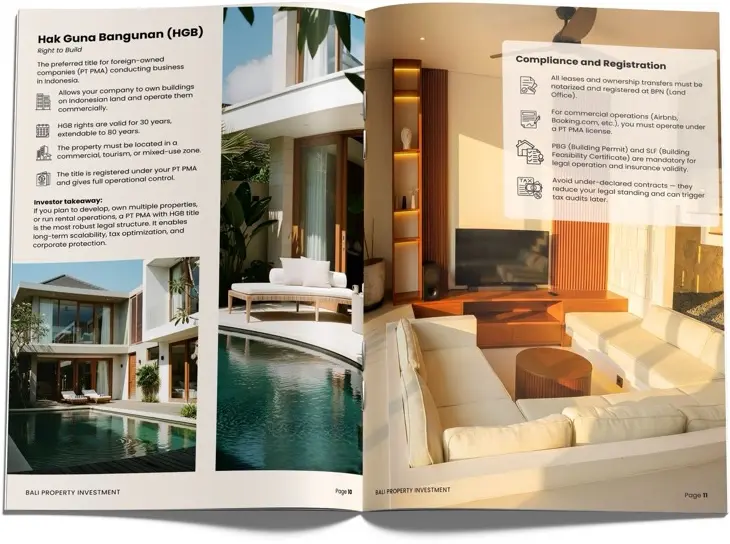
Hak Guna Bangunan (HGB) is a Right to Build title. A PT PMA (foreign-owned Indonesian company) can hold HGB for an initial 30 years, extendable by 20 years, then renewable for another 30 years. That gives a maximum of 80 years of control. The PT PMA owns the company, and the company owns the land title. This is the closest structure to freehold available to international investors.
Hak Pakai (Right to Use) allows a foreign individual to hold property directly for up to 80 years (30 + 20 + 30). Since 2026, Hak Pakai has become relevant for holders of Indonesia's Second Home Visa and Golden Visa. It suits residential use but has limitations for commercial rental operations.

Leasehold vs freehold Bali: side-by-side comparison
The table below compares the four ownership structures available to international investors in Bali.
| Criterion | Leasehold (Hak Sewa) | HGB via PT PMA | Hak Pakai (Individual) | Nominee Freehold |
|---|---|---|---|---|
| Who holds title | Indonesian landowner (you hold usage rights) | PT PMA company (you own the company) | You personally | Indonesian citizen (illegal structure) |
| Maximum term | 25-30 years (extensions negotiable) | 80 years (30 + 20 + 30) | 80 years (30 + 20 + 30) | Permanent on paper; unenforceable |
| Entry cost (typical 3-bed Canggu villa) | $180,000-$350,000 | $350,000-$700,000 + PT PMA setup | $300,000-$600,000 | Varies; high legal risk |
| PT PMA setup cost | Not required | $8,000-$12,000 (setup) + $3,000-$5,000/year (compliance) | Not required | Not applicable |
| Annual holding costs | Property tax (PBB) only: $200-$800/year | PBB + corporate tax filing + annual audit: $4,000-$8,000/year | PBB + personal tax obligations | Unpredictable; depends on nominee |
| Rental operation | Requires NIB + KBLI registration | Full commercial rights with NIB | Limited commercial use | No legal standing for rental permits |
| Resale | Sell remaining lease term | Sell company shares (no transfer tax on share sale) | Transfer to another qualifying foreigner | Cannot legally sell what you do not own |
| Capital appreciation | Declines as lease shortens | Appreciates like freehold | Moderate appreciation | No legal claim to appreciation |
| Legal risk | Low (when notarised properly) | Low (when BKPM-compliant) | Low (for qualifying visa holders) | Very high: unenforceable |
| Best for | 5-15 year investment horizon | 15+ year hold or multi-property portfolio | Personal residence, retirees | Not recommended under any circumstance |
Key takeaway: nominee freehold is the only structure Investland Bali will never arrange. The remaining three structures are all legally sound. Your choice depends on budget, timeline and intended use.
Real cost breakdown: leasehold vs PT PMA freehold

Numbers matter more than theory. Below are the actual costs for a comparable 3-bedroom Canggu villa. Data comes from Investland Bali's 2024-2025 transactions.
| Cost component | Leasehold (25-year term) | PT PMA + HGB |
|---|---|---|
| Property acquisition | $250,000 | $450,000 |
| Legal and notary fees | $2,000-$3,500 | $2,500-$4,000 |
| PT PMA setup | $0 | $8,000-$12,000 |
| BKPM registration | $0 | Included in PT PMA setup |
| Stamp duty (BPHTB, 5%) | $0 (lease, not transfer) | $22,500 (5% of NJOP) |
| Year 1 total | ~$255,000 | ~$495,000 |
| Annual compliance | $500 (PBB + insurance) | $5,500 (PBB + audit + filing + domicile) |
| 10-year holding cost | ~$260,000 | ~$545,000 |
The cost gap narrows over longer holding periods. A 25-year leasehold costs approximately $10,000 per year of ownership. A PT PMA freehold costs approximately $21,000 per year over the first 25 years. The critical difference: the PT PMA asset retains full market value at year 25. The leasehold value approaches zero.
From Investland Bali's portfolio: investors targeting 5 to 10 year holds with clear exit timelines consistently choose leasehold. Investors building multi-property portfolios or planning generational wealth choose PT PMA. Neither structure is inherently better. The right choice matches your investment thesis.
When leasehold is the stronger choice
Leasehold works best in three scenarios.
Short to medium investment horizon (5 to 15 years). You acquire a property at 30 to 50% below freehold market value. You generate rental income for the lease term. You sell the remaining lease years before the value curve steepens. Investland Bali's leasehold investors have achieved 9 to 12% net rental yields on properties in Canggu and Pererenan, with the lower acquisition cost driving higher yield percentages than equivalent freehold properties.
First Bali investment. Leasehold provides a lower-risk entry point. You learn the market, test the rental dynamics and build a relationship with your management team. Several Investland Bali clients started with a leasehold villa and later acquired a second property through a PT PMA after understanding the market firsthand.
Lifestyle use with rental income. If you plan to use the villa 4 to 8 weeks per year and rent it out the rest, leasehold delivers the lifestyle without the corporate compliance overhead. Pellago, Investland Bali's property management arm, manages leasehold and freehold properties identically. Guests do not know or care about your ownership structure.
The critical rule: negotiate extension terms at signing, not at renewal. A 25-year lease with a pre-agreed 25-year extension option is a 50-year asset. A 25-year lease with no extension clause is a depreciating asset from day one.
When PT PMA freehold is the stronger choice
PT PMA ownership suits investors with longer time horizons and larger capital commitments.
Multi-property portfolio building. A single PT PMA can hold multiple properties. Your second, third and fourth acquisitions do not require additional company setup. The annual compliance cost stays roughly the same whether the PT PMA holds one villa or five. This makes the per-property compliance cost decline with scale.
Long-term capital appreciation play. Bali property values have increased 15 to 25% annually in high-demand areas (Canggu, Pererenan, Uluwatu) over the past three years, according to PropertyGuru Indonesia's 2025 Market Report and BPS Bali construction data. With HGB title, you capture the full appreciation over 80 years. With leasehold, your asset value declines as the remaining term shortens.
Exit via share sale (tax efficiency). Selling PT PMA shares rather than transferring the underlying land title avoids the 5% transfer tax (BPHTB) and 2.5% income tax on property disposal. The buyer acquires the company, which already holds the title. This is a significant tax advantage on high-value properties. On a $500,000 villa, the tax saving is approximately $37,500. For more on exit planning, see our Bali real estate exit strategy guide.
Commercial rental operation. PT PMA provides the cleanest structure for obtaining NIB (Nomor Induk Berusaha), the business identification required for legal rental operations. Under 2026 regulations, every villa operating as a rental must hold Verified status through the OSS (Online Single Submission) portal. Properties without valid NIB and the correct KBLI (business classification code) risk being delisted from booking platforms.
Hak Pakai: the third option for qualifying foreigners

Hak Pakai (Right to Use) allows qualifying foreign individuals to hold property in their own name. No PT PMA is required. The title runs for 30 years, extendable by 20, then renewable for another 30. That gives a total of 80 years.
Who qualifies: holders of KITAS (limited stay permit), KITAP (permanent stay permit), Second Home Visa (D21A), or Golden Visa. If you hold one of these permits and plan to use the property as a personal residence, Hak Pakai avoids the PT PMA compliance overhead.
Limitations: Hak Pakai is designed for residential use. Commercial rental operations are restricted. If your primary goal is rental income, PT PMA with HGB remains the better structure. Hak Pakai also requires you to maintain a qualifying visa. If your visa lapses, your title status becomes complicated.
Investland Bali's recommendation: Hak Pakai works well for retirees on KITAP and Second Home Visa holders who want a personal residence in Bali. For investors seeking rental yields, PT PMA is more practical.
The nominee trap: why it fails

A nominee arrangement places Hak Milik title in an Indonesian citizen's name on behalf of a foreign buyer. Side agreements attempt to give the foreign buyer effective control. This structure is illegal under Indonesian law.
Indonesian courts have consistently ruled nominee agreements unenforceable. Article 26(2) of the Agrarian Law (UUPA 5/1960) voids any transfer that circumvents the nationality restriction. If the nominee claims the property, sells it or uses it as collateral for their own debts, the foreign "owner" has no legal recourse.
Investland Bali has seen nominee arrangements collapse with losses exceeding $150,000. These were investors who came to us after the fact. Some lost the property entirely. Others spent $30,000 to $50,000 in legal fees trying to recover assets. None succeeded.
The position is clear: Investland Bali does not arrange, recommend or facilitate nominee structures. Every ownership arrangement we structure is fully compliant with Indonesian law.
2026 regulatory changes affecting both structures
Two regulatory changes in 2026 affect property owners regardless of ownership type.
NIB and SLF compliance deadline (31 March 2026). Every villa operating as a short-term rental must hold a valid NIB (Business Identification Number), the correct KBLI code (55101 for hotel/villa operations), and a Sertifikat Laik Fungsi (SLF, Certificate of Building Worthiness). Properties without these documents risk being hidden from Airbnb, Booking.com and other platforms. Both leasehold and PT PMA properties must comply.
BKPM Regulation 5/2025 capital requirements. PT PMA companies investing in property must maintain IDR 2.5 billion (approximately $155,000) in paid-up capital, as outlined in the BKPM investment portal. This regulation has not changed the practical setup cost significantly, as the capital requirement was already in effect, but enforcement has tightened. Investland Bali has filed 60+ PT PMAs under this regulation with a 100% approval rate.
Practical impact: the compliance burden is higher for PT PMA owners (corporate tax filing, annual audit, domicile letter renewal). Leasehold owners face fewer administrative requirements. Both structures require NIB registration if the property generates rental income.

How to decide: the 5-question framework
Answer these five questions. The answers point to your optimal structure.
1. What is your investment horizon? Under 15 years: leasehold. Over 15 years: PT PMA or Hak Pakai.
2. What is your total budget? Under $300,000: leasehold delivers better yield-on-cost. Over $400,000: PT PMA becomes proportionally more cost-effective.
3. Will you acquire more properties? If yes, set up a PT PMA now. It holds multiple assets. If this is a one-time purchase, leasehold may be simpler.
4. Is rental income your primary goal? If yes, PT PMA provides the cleanest commercial licensing path. Leasehold works but requires careful NIB structuring.
5. Do you hold or plan to obtain a long-stay visa? If yes, Hak Pakai becomes an option for personal residential use.
No single structure is universally best. Investland Bali clients are split approximately 55% leasehold, 35% PT PMA and 10% Hak Pakai across our 120+ completed transactions.
Get our complete Bali Property Investment Guide with ownership structure decision matrix
Leasehold and freehold yields compared
Ownership structure affects your yield calculation. Here is how the numbers look on comparable Canggu villas, using Investland Bali's 2024-2025 portfolio data.
| Metric | Leasehold villa | PT PMA villa |
|---|---|---|
| Acquisition cost | $250,000 | $450,000 |
| Annual gross rental income | $38,000 | $42,000 |
| Annual operating costs | $8,000 | $12,500 |
| Annual net income | $30,000 | $29,500 |
| Net yield on cost | 12.0% | 6.6% |
| 5-year total return (income only) | $150,000 (60% of cost) | $147,500 (33% of cost) |
| Asset value at year 10 | ~$150,000 (declining) | ~$550,000 (appreciating) |
| 10-year total return (income + asset) | $450,000 | $842,500 |
Leasehold delivers higher annual yields because the acquisition cost is lower. PT PMA delivers higher total returns over longer periods because the asset appreciates. Neither is inherently superior. Your choice depends on whether you optimise for income or total wealth.
Returns are not guaranteed and depend on market conditions, property type and management quality.
Frequently asked questions
Can foreigners own freehold property in Bali?
How long is a standard leasehold in Bali?
What happens when a Bali lease expires?
Is leasehold safe for foreign investors in Bali?
How much does it cost to set up a PT PMA for property in Bali?
Can I convert a leasehold to freehold in Bali?
Which ownership structure gives better returns in Bali?
Choosing the right structure for your Bali investment
The leasehold vs freehold decision is not about which structure is better. It is about which structure matches your investment goals, timeline and budget.
Investland Bali structures both. Bali's land zones determine what you can build and where. Due diligence protects you regardless of structure. Villa insurance covers your asset once it is built. And off-plan purchases offer the best entry pricing for both leasehold and freehold buyers.
If you are still weighing the options, book a free strategy call to walk through your specific situation with real numbers.