Off-Plan Property Bali 2026: How It Works, What It Costs, and What to Watch


Off-plan property in Bali means purchasing during the construction phase, typically at 20 to 30% below completed market value. Build cycles run 9 to 18 months. Investors pay in staged instalments tied to construction milestones rather than the full amount upfront. Net ROI for off-plan ranges from 20 to 35% on completion, combining price appreciation and rental-ready delivery. Investland Bali has delivered 60+ off-plan units across Amari Villas, Temple Heights, and Element Residence, with every project completed on schedule and within budget.
Off-plan Property Bali is the most popular entry strategy for foreign investors in Bali. The pricing advantage is straightforward: developers price early-stage units below expected market value at completion to fund construction. The investor captures the appreciation. In a market where the median sold price is $299,000 and supply is constrained by a 15-metre island-wide height limit, buying below market and holding for appreciation is a structurally sound approach.
But off-plan also carries risks that ready-built properties do not. Developer quality, permit status, construction delays, and contract structure all affect the outcome. This guide covers how off-plan works in Bali, what the real returns look like, how to evaluate a developer, and what the buying process involves step by step.

Off-Plan Property Bali vs Ready-Built: The Numbers
The core trade-off is price and risk. Off-plan is cheaper and offers higher total return, but requires patience and developer trust. Ready-built is more expensive but delivers immediate income with no construction risk.
ROI Comparison Table
| Factor | Off-Plan | Ready-Built |
|---|---|---|
| Purchase price (2-bed, Canggu) | $180,000 to $280,000 | $250,000 to $380,000 |
| Price discount vs market | 20 to 30% below completion value | Market price |
| Capital appreciation to completion | 20 to 30% | N/A (already at market) |
| Time to first rental income | 9 to 18 months (build period) | Immediate |
| Construction risk | Yes (developer dependent) | None |
| Customisation | Yes (finishes, layout tweaks) | Limited (cosmetic only) |
| Payment structure | Staged (monthly or milestone-based) | Full payment or mortgage |
| Net rental yield (once operating) | 10 to 15% | 10 to 15% |
| Total ROI at year 3 (appreciation + yield) | 50 to 70%+ | 30 to 45% |
| Due diligence complexity | Higher (developer + land + permits) | Lower (property exists) |
When off-plan wins: you have a 12+ month horizon, can tolerate construction wait, want the pricing advantage, and have done your developer homework. This is the default path for 80% of Investland Bali’s portfolio investors.
When ready-built wins: you need immediate rental income, want to inspect the physical property before buying, or lack the risk tolerance for construction delays. Budget 15 to 30% more for the same property type.
For a detailed comparison of investment strategies (buy-to-rent, flip, hybrid), see Bali property investment strategies.
How Off-Plan Pricing Works
Developers release off-plan units in stages. Each stage is priced higher than the last as construction progresses and risk decreases.
Stage 1 (pre-construction). The lowest price point. Typically 25 to 30% below expected completion value. Highest risk (construction has not started), highest reward. Available before or just after groundbreaking.
Stage 2 (foundation and structure). Price increases 10 to 15% from stage 1. The project is physically underway. Investors can visit the site and verify progress.
Stage 3 (fit-out and finishing). Price increases another 5 to 10%. The building is structurally complete and being fitted out. Delivery timeline is clear.
Completion (handover). Full market price. The property is ready for occupancy or rental. Investors who bought at stage 1 have typically seen 20 to 30% appreciation by this point.
Real example from Investland Bali: Amari Villas stage 1 units were priced from $180,000. By completion, comparable villas in the same area were selling at $220,000 to $250,000. Investors who entered at stage 1 captured 20 to 25% capital appreciation before the first guest checked in.
One client purchased at $67,000 (off-plan loft), found a buyer at $91,850 within a month, making the gain without ever taking possession.
Payment Structures
Off-plan payments are staged, not lump-sum. This reduces the upfront capital commitment and aligns your exposure with construction progress.
Typical Payment Schedule
| Milestone | Percentage | Typical Timing |
|---|---|---|
| Reservation deposit | 5 to 10% | Day 1 (refundable during due diligence) |
| Contract signing | 20 to 30% | Week 2 to 4 (after due diligence) |
| Foundation complete | 15 to 20% | Month 2 to 4 |
| Structure complete | 15 to 20% | Month 5 to 8 |
| Fit-out and finishing | 10 to 15% | Month 8 to 12 |
| Handover (final payment) | 5 to 10% | Completion (retain until defects cleared) |
Monthly payment plans are offered by some developers, including Investland Bali, spreading the total across the build period. This is popular with investors who prefer to deploy capital gradually rather than in large milestone chunks.
The retention clause. Hold back 5 to 10% of the total until the developer resolves any defects identified during the handover inspection. This is standard practice and should be written into the contract. Any developer who resists a retention clause is a red flag.
What Investland Bali Is Building
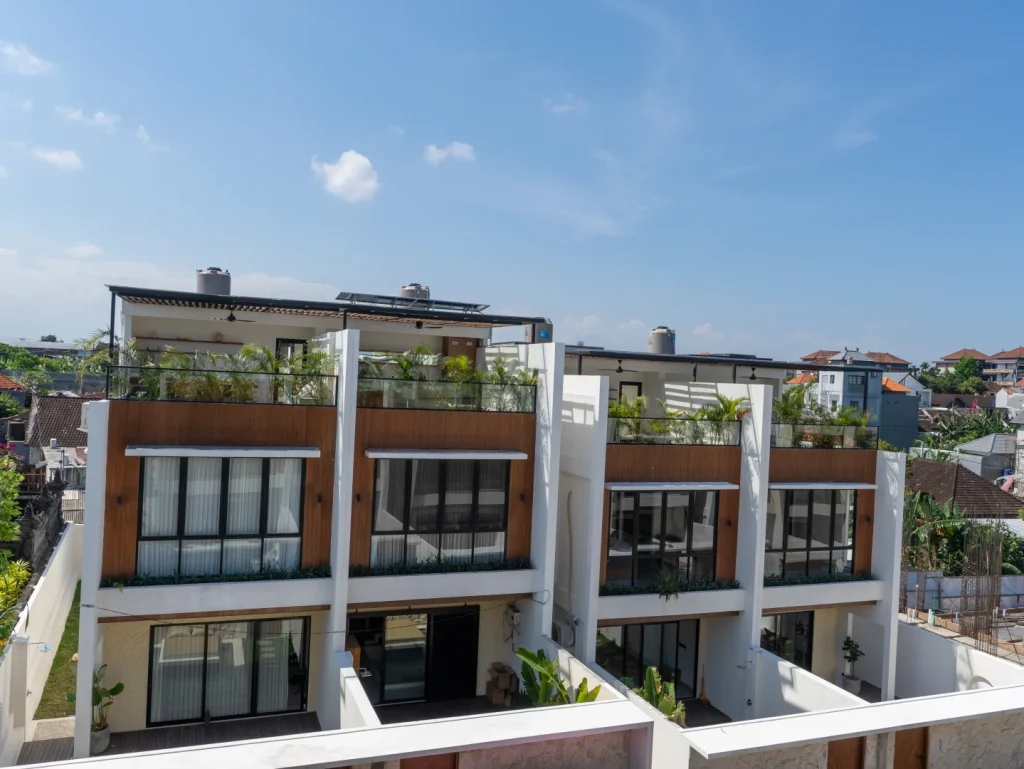
Three active developments at different price points and product types. All off-plan, all in the Canggu corridor.
Amari Villas
Modern 2 to 3 bedroom pool villas in Padonan, Canggu. Private garden, swimming pool, fully furnished. Entry-level investment positioned for rental yield. Multiple stages delivered (Stage 1 and 2 complete, Stage 3 available as 1-bedroom cottage-style villas from $145,000). Strong rental performance through Pellago management. See Amari Villas listing.
Temple Heights
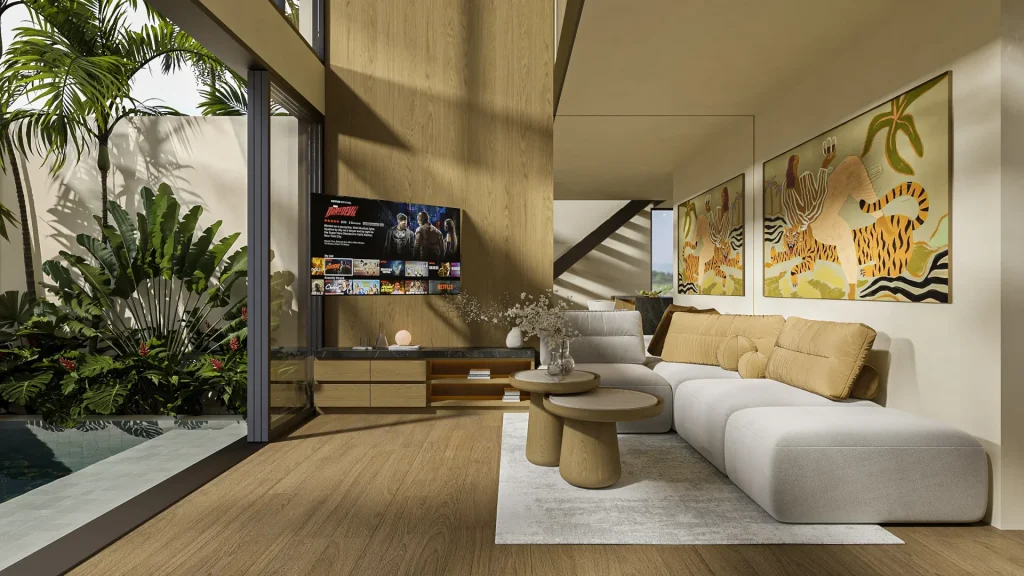
15 fully furnished riverside lofts in Padonan, Canggu. 1 and 2 bedroom configurations. Higher price point ($182,000+) targeting investors seeking premium design and higher nightly rates. Designed by Luup.design with tropical-modern architecture. Flexible payment plan and comprehensive property management included. See Temple Heights listing.

Element Residence
107-unit serviced apartment complex with 3,000+ sqm of commercial space on Jl. Nelayan, Canggu. Joint development with Wahi Group. Hotel-operated by Sono Hotels and Resorts with rental pool revenue sharing. Studios, lofts, and penthouses from approximately $130,000 to $510,000. Leasehold until 2075. Currently on waitlist for early-stage pricing. See Element Residence details.
All three projects are built by Constructland (Investland’s construction arm) and designed by Luup.design (in-house architecture). This vertical integration means design, construction, and management quality are controlled end-to-end. View all projects at Investland Bali Developments.

How to Evaluate an Off-Plan Developer
Developer selection is the single highest-impact decision in off-plan investing. A good developer delivers on time, on budget, and to spec. A poor developer delivers delays, cost overruns, or an unfinished project.
Seven checks before committing capital:
- Visit completed projects. Walk through a finished development, not a show unit. Check build quality, materials, finishes, and ask current owners about their experience. If the developer has no completed projects, that is not necessarily disqualifying, but it demands extra scrutiny.
- Verify permits. Confirm PBG (Building Approval), SLF (Worthiness Certificate), and land title at BPN. A developer who does not hold valid permits is selling a product they may not be able to legally build.
- Check the business licence. Verify the developer’s SIUP (business licence), PT or PT PMA registration, and NIB through the OSS system. A legitimate developer is a registered, compliant Indonesian business entity.
- Review the payment structure. Milestone-based payments protect you. Monthly payments with no milestone link are riskier. 100% upfront is a non-starter. Retention clauses should be standard.
- Ask about construction financing. Does the developer fund construction from investor deposits only, or do they have equity in the project? Developers who invest their own capital (as Investland Bali does) are less likely to abandon a project because their money is at risk too.
- Request construction updates. Reputable developers provide regular photo and video updates at each milestone. Ask for examples from current projects. No updates equals no accountability.
- Check the management plan. What happens after handover? Who manages the rental? What are the projected yields and on what assumptions? A developer who builds but has no operational plan for the completed property is leaving money on the table for the investor.
For the full property verification process, see our due diligence guide for Bali property.
The Off-Plan Buying Timeline
From first interest to rental income, the process follows a predictable path.
Timeline: Deposit to Income
| Phase | Duration | What Happens |
|---|---|---|
| Research and selection | 2 to 4 weeks | Visit developments, compare options, evaluate developer |
| Due diligence | 2 to 4 weeks | Title check at BPN, permit verification, legal review |
| Contract and deposit | 1 to 2 weeks | Sign SPA, pay reservation deposit, begin staged payments |
| Construction | 9 to 18 months | Monthly or milestone payments, regular construction updates |
| Handover and inspection | 1 to 2 weeks | Walk-through, defect list, final payment (minus retention) |
| PT PMA setup (if not done) | 4 to 8 weeks | Can run parallel with construction |
| Furnishing and listing | 2 to 4 weeks | Furnish, photograph, list on Airbnb/Booking |
| First rental income | Month 12 to 22 | Property operational, guests booking |
Total time from decision to income: 12 to 22 months. Off-plan purchases made through a PT PMA can begin the company setup process in parallel with construction, saving 4 to 8 weeks at the back end.
For the step-by-step legal process of buying, see how to buy property in Bali as a foreigner.
Risks and How to Manage Them
Off-plan carries specific risks that ready-built properties do not. All are manageable with proper due diligence.
Construction delays. Weather, material shortages, permit complications, or developer cash flow issues can push timelines. Mitigation: choose developers with completed projects and their own capital at risk. Include penalty clauses in the contract for delays beyond a defined grace period.
Developer insolvency. If the developer runs out of money, your partially-built property is at risk. Mitigation: milestone-based payments (not lump-sum), verify the developer has equity invested, and use a notarised contract through an independent PPAT.
Quality shortfalls. The finished product does not match the plans. Mitigation: detailed scope of work in the contract specifying materials, finishes, and fixtures. Retention clause (5 to 10%) held until defects are resolved. Visit the developer’s completed projects before committing.
Market timing. If Bali’s property market softens during your build period, the appreciation you expected may not materialise. Mitigation: buy for yield, not just appreciation. A property that generates 10 to 15% net rental yield is a good investment regardless of short-term price movements.
Zoning or permit issues. The developer may not have all permits in order. Mitigation: independent due diligence on zoning (KKPR), PBG, and land title before any payment. See our land zones guide for details on what is buildable where.
Ready to Explore Off-Plan Property Bali?
Every off-plan investment starts with the right development and the right structure. Walk through current availability across Amari Villas, Temple Heights, and Element Residence, or view all projects at investlandbali.com/developments.
Download our free Bali Investment Guide for real ROI numbers and development comparisons, or book a 30-minute investment consultation for an honest assessment of which development fits your capital and timeline.