Bali Real Estate Mistakes: 9 Costly Errors Foreign Investors Make (2026)


Foreign investors in Bali lose between $10,000 and $150,000+ on avoidable mistakes every year. The nine most costly errors: using illegal nominee structures, skipping land zoning verification, underestimating total acquisition costs, choosing the wrong ownership structure, neglecting title due diligence, ignoring ongoing operational costs, buying on emotion rather than data, misunderstanding rental regulations and failing to plan an exit strategy.
Bali real estate mistakes cost foreign investors more than market downturns ever have. Property values across Canggu, Pererenan and Uluwatu have risen 15% to 25% since 2022, and net rental yields of 8% to 12% draw capital from Europe, Australia and Asia. The market rewards informed buyers.
But the same conditions that create opportunity also attract rushed decisions. Industry data from Indonesian notarial associations and property lawyer networks shows consistent patterns: the costliest problems are not market risks. They are process mistakes that could have been prevented with proper structure and professional guidance.
This article documents nine mistakes that surface repeatedly in Bali’s foreign investor market, quantifies the financial damage each one causes and provides specific steps to avoid them.
This guide is for informational purposes. Consult a qualified Indonesian property lawyer before making any purchase decision.
1. Using a nominee structure

A nominee arrangement is when a foreigner pays for property but registers it in an Indonesian citizen’s name. It is the single most dangerous mistake a foreign investor can make in Bali.
Why people do it: it appears to bypass Indonesia’s foreign ownership restrictions, allowing foreigners to hold freehold (Hak Milik) land at lower cost than setting up a PT PMA company.
Why it fails: nominee structures are explicitly prohibited under Indonesian Agrarian Law No. 5/1960 and Government Regulation No. 24/1997. If challenged, the Indonesian nominee is the legal owner. The foreign buyer has no enforceable claim. Courts have consistently ruled against foreigners in nominee disputes.
Estimated cost: total loss of the property. For a $200,000 to $500,000 villa, that is a complete write-off. An estimated 10,500 properties across Bali are held through nominee arrangements, according to Indonesian notarial association data reported by Jakarta Globe.
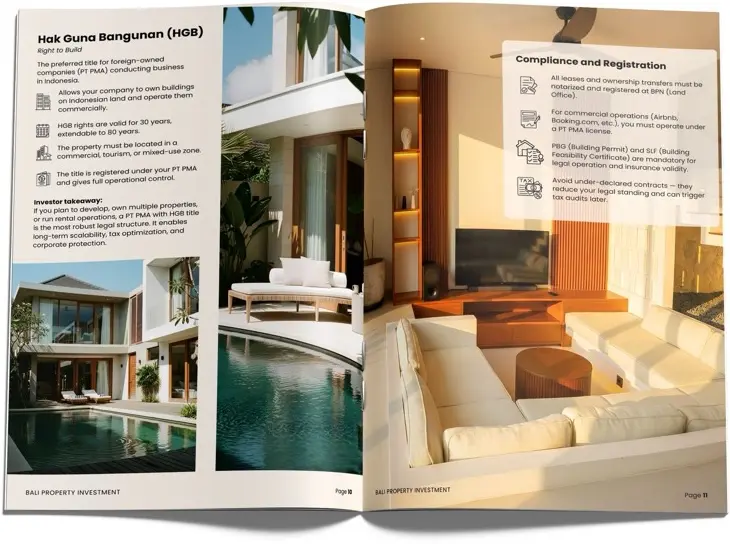
Prevention: use one of the three legal ownership structures. A 25 to 30 year leasehold (Hak Sewa) is the simplest. A Hak Pakai right-to-use title works for residents with KITAS/KITAP visas. A HGB with PT PMA foreign investment company suits investors who plan to rent commercially. PT PMA setup costs around $3,000 and takes 4 to 6 weeks. That is a fraction of the asset it protects.
2. Skipping land zoning verification

Every parcel of land in Bali falls within one of five colour-coded zones defined in the Rencana Tata Ruang Wilayah (RTRW), the provincial spatial plan. Buying land without checking the zone is one of the most expensive mistakes in the market.
| Zone colour | Classification | What you can build | Common mistake |
|---|---|---|---|
| Green | Conservation / agriculture | Nothing (protected) | Buying “cheap farmland” that cannot be developed |
| Yellow | Residential | Houses, villas (private use) | Assuming you can legally rent to tourists |
| Pink | Tourism / commercial | Hotels, rental villas, restaurants | Overpaying based on tourism zoning premium |
| Orange | Mixed-use | Commercial + residential | Not verifying which uses are actually permitted |
| Red | Infrastructure / government | Roads, public facilities | Buying land with future government acquisition risk |
Estimated cost: $50,000 to $200,000+. A foreign investor who buys a $150,000 plot in a green zone cannot build on it, cannot get permits and cannot easily resell it because the next buyer faces the same restrictions. Indonesian authorities have increased enforcement of green zone building restrictions throughout 2025 and 2026.
Prevention: before signing any agreement, request the Surat Keterangan (zoning certificate) from the local Badan Pertanahan Nasional (BPN) office. Verify the zone against the current RTRW map. This costs under $100 and takes 3 to 5 business days. For a full explanation of Bali’s five zones, see our land zones guide.
3. Underestimating total acquisition costs

The listing price is not the total cost. Foreign buyers who budget only for the property price face a 15% to 25% cost overrun that erodes their projected returns before they collect a single dollar of rental income.
| Cost category | Typical range | Notes |
|---|---|---|
| Property purchase price | 100% of budget | The number everyone focuses on |
| Notary and legal fees | 1% to 2% | PPAT (land deed official) + lawyer fees |
| Transfer tax (BPHTB) / Freehold | 5% of assessed value | Buyer pays; based on NJOP, not market price |
| Seller income tax (PPh) / Freehold | 2.5% of assessed value | Seller pays, but often negotiated into price |
| PT PMA setup (if applicable) | $3,000 | One-time; includes OSS registration. |
| Building permits (IMB/PBG) | $1,000 to $3,000 | Required for new builds and major renovations |
| Furnishing and fit-out | $15,000 to $50,000+ | For rental-ready properties |
| Insurance (first year) | $500 to $2,000 | Property All Risk + earthquake coverage |
| Property management setup | $500 to $1,500 | Onboarding, listing creation, photography |
Estimated cost: $15,000 to $40,000 in unplanned expenses. Investors who do not budget for these costs either run out of capital before the property is rental-ready or must accept a lower standard of fit-out that reduces their rental yield.
Prevention: build a total cost model before committing. Request a comprehensive cost breakdown from your developer or agent at the Letter of Intent stage, covering every line item from land tax to listing setup. Any reputable developer should provide this transparency upfront.
4. Choosing the wrong ownership structure
Indonesia offers three legal routes for foreign property ownership. Each has different costs, rights, timelines and restrictions. Choosing the wrong one creates problems that are expensive and time-consuming to fix.
| Structure | Cost to set up | Ownership duration | Can rent legally? | Can sell/transfer? | Best for |
|---|---|---|---|---|---|
| Leasehold (Hak Sewa) | $500 to $1,500 (legal fees) | 25 to 30 years (renewable) | Only if zoned for tourism + licensed + PT PMA | Transfer remaining lease term | Lifestyle buyers, single-property investors |
| Hak Pakai (Right to Use) | $1,000 to $2,000 | 30 + 20 + 30 years (max 80) | Limited | Transfer with conditions | Residents with KITAS/KITAP |
| HGB through PT PMA | $3,000 | Perpetual (company-owned) | Yes (with TDUP/NIB licence) | Sell shares or assets | Rental operators, multi-property portfolios |
More on ownership structures here: Buying Property in Bali
Prevention: decide your investment strategy before choosing a structure. If you plan to rent the property, a PT PMA is almost always the correct choice. If you plan personal use only, a leasehold is simpler and cheaper.
5. Neglecting title and land due diligence

Title fraud, boundary disputes and encumbered certificates are real risks in Bali’s property market. The island’s land registry system has historical gaps, and not all certificates are accurate or current.
Common due diligence failures:
- Not checking for liens, mortgages or court orders against the certificate
- Accepting a photocopy of the land certificate without verifying the original at BPN
- Not surveying the physical boundaries against the certificate measurements
- Missing inheritance claims from family members not listed on the certificate
- Not checking building permit (IMB/PBG) validity and compliance
Prevention: engage an independent Indonesian property lawyer (not the seller’s notary) to conduct full due diligence before signing. This costs $1,000 to $3,000 and covers certificate verification at BPN, boundary survey, lien search, zoning confirmation and permit review. This is non-negotiable for any purchase above $50,000.
6. Ignoring ongoing operational costs

Many investors project rental returns based on gross income without accounting for the operational costs that reduce net yield by 30% to 45%. This is the gap between the 12% to 15% gross figures in marketing materials and the 8% to 10% net yield that investors actually receive.
| Expense | Monthly estimate (USD) | Annual total |
|---|---|---|
| Property management (15% to 25% of rental income) | $200 to $600 | $2,400 to $7,200 |
| Pool maintenance | $80 to $150 | $960 to $1,800 |
| Garden and landscaping | $60 to $120 | $720 to $1,440 |
| Security (guard or system) | $100 to $250 | $1,200 to $3,000 |
| WiFi and utilities | $100 to $200 | $1,200 to $2,400 |
| Pest control | $30 to $50 | $360 to $600 |
| Annual property tax (PBB) | Varies | $200 to $800 |
| Annual insurance | Varies | $500 to $2,000 |
| Maintenance reserve (2% to 3% of property value) | Varies | $3,000 to $9,000 |
| OTA commissions (Airbnb, Booking.com: 3% to 18%) | Varies | $1,500 to $6,000+ |
For a $300,000 villa generating $48,000 per year in gross rental income, total operating costs typically range from $14,400 to $21,600. That leaves a net yield of 9% to 11%, not the 16% gross figure in the marketing deck. Understanding this gap before you buy is what separates successful investors from disappointed ones.
Prevention: model net yield, not gross. Insist that your property manager provides transparent monthly reporting so you see exactly where every dollar goes. For a detailed breakdown of how net yields are calculated across Bali’s investment areas, see our rental yield analysis.
7. Buying on emotion, not data

Bali’s lifestyle appeal makes emotional purchasing a persistent problem. Investors fall in love with a view, a neighbourhood or a villa design and commit before analysing the numbers.
Signs of emotional buying:
- No comparable sales analysis for the area
- No rental yield projection based on actual occupancy data
- No check of the area’s infrastructure pipeline (roads, water, electricity capacity)
- Buying in an oversaturated area because “everyone is buying there”
- Paying a premium for finishes rather than evaluating land value and build cost separately
Estimated cost: 10% to 30% overpayment on purchase price, plus below-market rental yields. A $300,000 villa bought at a 20% premium versus comparable properties starts $60,000 underwater from day one.
Prevention: always obtain a comparative market analysis before making an offer. Request area-specific yield data, occupancy benchmarks and comparable recent transactions from your agent. Our area comparison guide covers pricing trends, yield data and infrastructure catalysts across Canggu, Uluwatu, Pererenan, Ubud and Sanur. Our Bali real estate market report provides broader market context.
8. Misunderstanding rental regulations
Operating a short-term rental in Bali requires specific licences and regulatory compliance. The regulatory environment has tightened since 2024, and properties that operated informally before now face enforcement.
Key regulatory requirements:
- Tourism zoning: the property must sit in a pink (tourism) or orange (mixed-use) zone
- TDUP (Tourism Business Registration): mandatory for any property renting to tourists
- NIB (Business Identification Number): obtained through the OSS (Online Single Submission) system
- Pondok Wisata licence: required for small-scale villa rentals (under 15 rooms)
- Tax registration: rental income is subject to PPh (income tax) at 10% for PT PMA entities and withholding tax on foreign individual income
As of early 2026, approximately 40% of existing rental properties in Bali remained non-compliant with updated regulatory standards, according to industry estimates from the Bali Provincial Government. Properties found operating without proper licences face fines, closure orders and loss of OTA listing eligibility.
Prevention: establish proper licencing before listing your property on any rental platform. A PT PMA structure is the most straightforward path to obtaining tourism business licences. Work with a developer who includes pre-configured legal structures and all required permits as part of the purchase.
9. No exit strategy

Every investment needs a plan for getting capital out. In Bali, exit options depend entirely on the ownership structure chosen at purchase (see Mistake #4). Investors who do not plan their exit at the start often discover their options are more limited and more expensive than expected.
| Structure | Exit options | Timeline | Typical exit cost |
|---|---|---|---|
| Leasehold | Sell remaining term; negotiate renewal; let lease expire | 2 to 6 months | 10% Seller Tax |
| Hak Pakai | Transfer title to another eligible foreigner | 3 to 6 months | 5% to 7% (transfer tax + legal) |
| PT PMA | Sell shares (faster, lower tax) or sell assets (slower, higher tax) | 1 to 4 months for shares; 3 to 8 months for assets | 0.5% to 2.5% for share sale; 5% to 7% for asset sale |
Estimated cost: 5% to 15% of property value in reduced exit proceeds. A leasehold with only 10 years remaining sells at a steep discount compared to one with 25 years. A PT PMA with messy books or outstanding tax liabilities takes months longer to close and fetches a lower price.
Prevention: plan your exit at the time of purchase, not when you want to sell. Structure ownership for your most likely exit scenario. Keep PT PMA accounts clean and tax filings current. For detailed exit planning, see our exit strategy guide.
Bali Real Estate Mistakes: The cost of getting it wrong vs. getting it right
| Approach | Typical cost | Typical outcome |
|---|---|---|
| DIY purchase with no professional guidance | $0 upfront | $10,000 to $150,000+ in avoidable losses |
| Professional guidance (legal + advisory) | $5,000 to $10,000 | Correct structure, clean title, proper licencing, realistic yield |
The difference between a successful Bali property investment and a cautionary tale is almost never the market. It is the process. Every mistake in this list is preventable. The common thread is that prevention costs a fraction of the cure: $3,000 to $10,000 in upfront professional fees versus $10,000 to $150,000+ in losses from a single unstructured decision.
Start with the right structure
If you are considering a Bali property purchase and want to avoid these mistakes, a strategy call with an experienced team is the most cost-effective first step. It costs nothing, takes 30 minutes and covers ownership structuring, area selection and realistic return projections based on your goals.
Returns are not guaranteed and depend on market conditions, property type, operator performance and management quality.
About the author
Kristjan Ploompuu is the CEO of Investland Bali Properties. He has guided over 100 international investors from 18+ countries through Bali real estate transactions, overseeing more than EUR 120 million in lifetime transaction value. He leads Investland Bali’s investment strategy, legal structuring and partner selection.
Published: April 2026 | Last updated: June 2026