
Goldman Sachs: Indonesia to Be 4th-Largest Economy by 2050

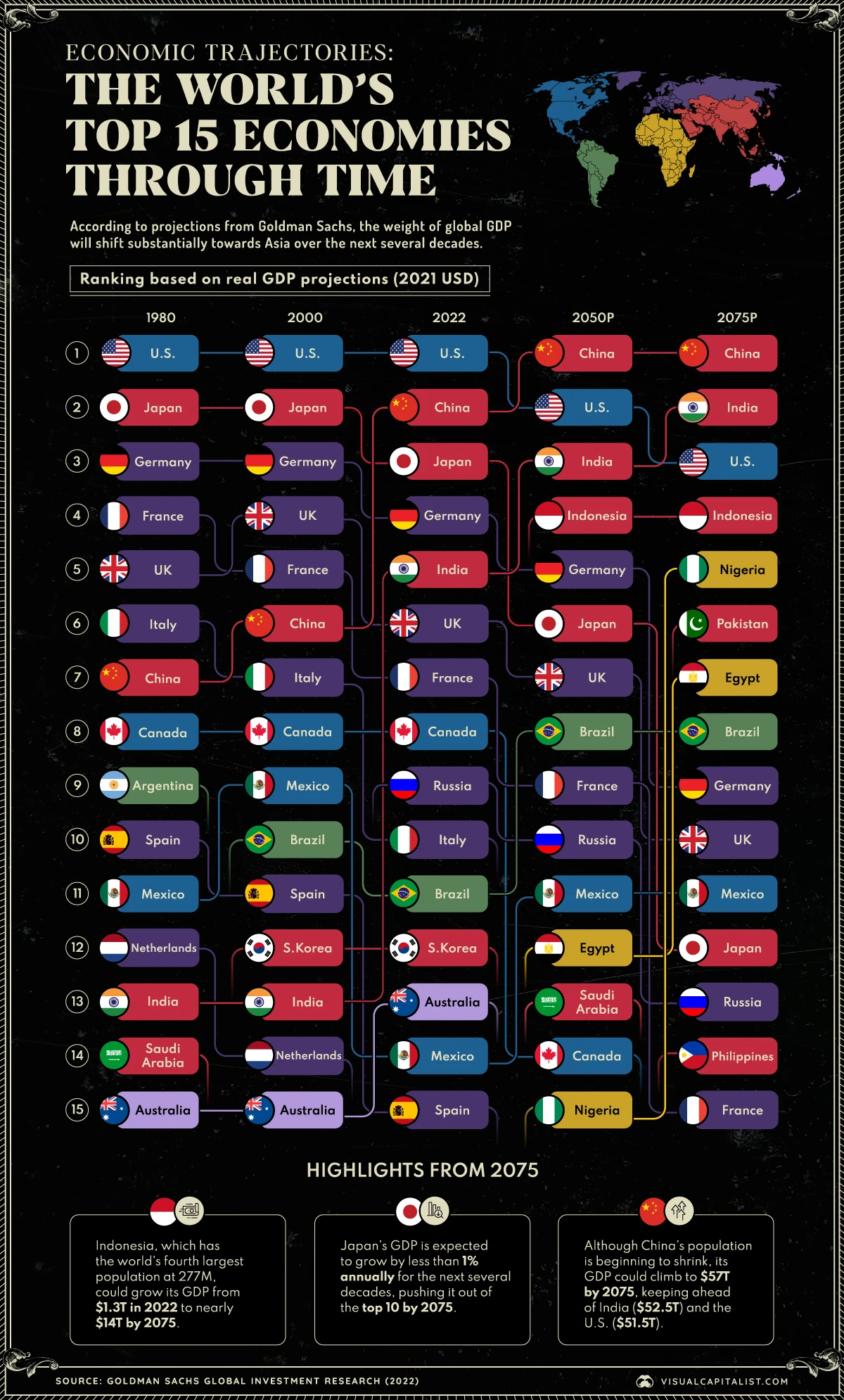
Goldman Sachs projects Indonesia will become the world’s fourth-largest economy by 2050, overtaking Germany, the United Kingdom, France, Russia, and Brazil in US dollar GDP terms. The forecast, published in the bank’s 2022 “Path to 2075” report and reaffirmed in subsequent updates, rests on three structural drivers: a demographic sweet spot with 70% of the population in prime working age, world-leading reserves of nickel and cobalt for the EV transition, and a digital economy that has expanded tenfold since 2015.
Goldman Sachs Indonesia: When Goldman Sachs published “The Path to 2075” in December 2022, the headline most English-language media picked up was China and India overtaking the United States. The more interesting story, largely ignored by Western press, was the rise of Indonesia. By 2050, the bank’s economists project, Indonesia will be the fourth-largest economy on earth. By 2075, it remains in the top four, behind only China, India, and the United States.
For foreign investors studying where to place long-term capital, this is not a rounding error. It is a structural rewrite of the global economic map, and one of the most direct ways to position in front of it is Indonesian real estate. This analysis walks through what Goldman Sachs actually said, why the forecast is credible, and what it means for international investors looking at Bali property in 2026.
What Goldman Sachs Actually Said
Goldman Sachs’ “Path to 2075” report is a long-range GDP forecasting exercise across 104 countries, published by the bank’s Global Markets Institute. The analysis uses a standard growth-accounting framework: labour force growth, capital deepening, and total factor productivity. Indonesia’s projected rise is not based on commodity optimism or a single sector bet. It is a demographic and productivity story.
The specific projection ranks the ten largest economies in 2050 by nominal GDP in US dollars:
| 2050 Rank | Economy | Today’s Rank (2025) |
|---|---|---|
| 1 | China | 2 |
| 2 | United States | 1 |
| 3 | India | 5 |
| 4 | Indonesia | 16 |
| 5 | Germany | 3 |
| 6 | Japan | 4 |
| 7 | United Kingdom | 6 |
| 8 | Brazil | 10 |
| 9 | France | 7 |
| 10 | Russia | 11 |
Source: Goldman Sachs “Path to 2075” (2022), ranking table for nominal GDP in USD.
Indonesia’s move from 16th to 4th is the largest single ranking gain in the forecast, larger than India’s move from 5th to 3rd. By 2075 the ranking consolidates: China first, India second, the United States third, Indonesia fourth.
It is worth saying plainly what this means. Indonesia is not projected to be a regional player. In the Goldman Sachs model it is projected to be, within a generation, a larger economy than Germany, Japan, the UK, and France. If the forecast plays out at even 60% of its stated trajectory, the consequences for Indonesian real estate, tourism infrastructure, and foreign direct investment are material.
Why Indonesia, Not Just Another Emerging Market
Vietnam has a demographic story. The Philippines has a labour-export story. Thailand has a tourism story. Indonesia has all three, at greater scale, with a 280 million population that is four times the size of Vietnam’s and already the largest in Southeast Asia.
Three structural differences set Indonesia apart from its regional peers:
Scale of the domestic market. Indonesia’s middle class reached roughly 60 million in 2024 per the World Bank, and is on track to double by 2030. That is a consumer market larger than all of Vietnam, similar in size to Germany. Foreign direct investment is no longer arbitrage on cheap labour; it is positioning in front of consumer demand.
Institutional continuity across political transitions. Joko Widodo’s ten-year presidency (2014 to 2024) delivered a decade of infrastructure investment and foreign-investment reform. When President Prabowo Subianto took office in October 2024, he signalled continuity on the FDI agenda. The clearest recent evidence: BKPM Regulation 5/2025 cut the minimum paid-up capital for foreign-owned Indonesian companies from IDR 10 billion to IDR 2.5 billion, a 75% reduction that materially lowered the entry cost for smaller international investors.
Strategic position in the EV and renewable energy transition. Indonesia holds roughly 50% of the world’s nickel reserves and 30% of its cobalt, both essential inputs to electric vehicle batteries. The country has used export restrictions on raw nickel to force domestic processing and attract Chinese, Korean, and Japanese battery manufacturers. This is not speculative. Hyundai, LG, CATL, and Tesla have all announced Indonesian production or supply commitments between 2022 and 2025.
The 6 Growth Drivers Behind the Forecast
Goldman Sachs’ model treats Indonesia’s trajectory as the product of six interlocking drivers. Each one is individually credible, and they reinforce each other.
1. Demographic sweet spot
Roughly 70% of Indonesia’s 280 million people are of working age. The dependency ratio is favourable and will remain so until roughly 2045. By comparison, China’s working-age share has already peaked and is now declining. Germany’s has been below 66% since 2020. Indonesia’s demographic window is approximately two decades wide, and the GDP forecast assumes it is captured.
2. Natural resources
Indonesia is the world’s largest nickel producer, top two in cobalt, top five in coal and palm oil, and a top ten LNG exporter. The strategic shift over the past five years has been from raw-commodity export to domestic processing, adding value before export. For a forecast that depends on productivity growth, that matters more than reserve size alone.
3. Digital economy
Indonesia’s digital economy was estimated at roughly USD 40 billion in 2015 and crossed USD 130 billion in 2024, per the Google-Temasek-Bain e-Conomy SEA report. That is a roughly tenfold expansion in a decade. Four Indonesian tech companies reached unicorn valuations during this period. Digital access enables scale for education, healthcare, and financial services across a country that covers 1.9 million square kilometres and 17,000 islands.
4. Institutional quality
The Goldman Sachs report explicitly notes that Indonesia’s institutional quality, while improving, is below the average of the economies it is projected to overtake. This is a qualifier, not a fatal flaw. The forecast builds in gradual improvement. The World Bank’s Worldwide Governance Indicators show Indonesia in the 50th-percentile band on government effectiveness, up from the 30th-percentile band in 2000. The trend is directional, not accidental.
5. Rising middle class
The World Bank estimates Indonesia’s middle class at roughly 60 million in 2024, projected to reach 130 million by 2030. Middle-class consumption drives domestic demand, which in turn drives services-sector employment, which in turn drives household formation. For property markets, household formation is the single most important demand driver. Indonesia’s household formation trajectory through 2045 is among the strongest in any major economy.
6. Open FDI policies
The Jokowi-era Omnibus Law (2020) simplified foreign investment rules. The OSS (Online Single Submission) system reduced business-licensing time from months to days. BKPM Regulation 5/2025 cut PT PMA minimum capital by 75%. Each step reduces friction for international investors. For context on how this affects real property purchases, see our guide on how international investors can legally own Bali property.
Goldman Sachs Indonesia: What This Means for Bali Property Investors
For international investors reading this as a macro forecast, the practical question is: how do you position in front of a GDP trajectory like Indonesia’s? There are three direct answers: Indonesian equities, Indonesian sovereign bonds, and Indonesian real estate. Of the three, real estate is the only one that offers both capital appreciation and operating income, and the only one where a well-structured investment can also serve as a residence or lifestyle asset.
Within Indonesian real estate, Bali occupies a specific position. It is the country’s largest destination for international property buyers, concentrated in Canggu, Uluwatu, Pererenan, and Ubud. The demand is driven by a combination of tourism recovery (Bali received 6.3 million international arrivals in 2024, exceeding the 2019 pre-pandemic peak), remote-work relocation, and retirement migration from Australia, the UK, the Netherlands, and increasingly from the Baltics and the Gulf.
Three data points matter for investors sizing the opportunity:
Delivered yields. Across Investland Bali’s completed villa projects, gross rental yields have ranged between 7% and 15% depending on location, finish level, and management quality. Canggu boutique villas in the USD 300,000 to 500,000 band have consistently delivered in the 9% to 12% range. These are delivered yields from 100+ international investors, not pro-forma projections. Returns are not guaranteed and depend on market conditions, property type, and management.
Appreciation trajectory. Bali property prices have compounded at roughly 7% per year between 2019 and 2025, with premium districts such as Uluwatu running higher. If Indonesia’s broader economic rise continues at even half the Goldman Sachs trajectory, there is no structural reason to expect Bali appreciation to reverse.
Entry mechanics for international investors. Foreign nationals cannot own freehold land in Indonesia directly. The three legal routes are leasehold (25 to 30 years), Hak Pakai right-to-use title, or a PT PMA foreign-investment company that can own freehold. BKPM Regulation 5/2025 made PT PMA meaningfully more accessible by cutting the capital requirement from IDR 10 billion to IDR 2.5 billion. For an investor deploying between USD 250,000 and USD 1 million, the PT PMA route is now economically sensible.
The connective logic is straightforward. Goldman Sachs’ forecast implies sustained capital inflows into Indonesia for two decades. Foreign direct investment tends to concentrate in urban commercial property (Jakarta) and destination real estate (Bali). Bali property acquired in 2026 at current yields benefits from both ongoing yield (7% to 15% gross) and underlying market appreciation in a country whose economy is projected to quadruple in nominal terms by 2050.
For context on the end-to-end process, see our guides on due diligence before purchase, exit strategies for international investors, and the seven most common investment mistakes and how to avoid them.
Risks to the Forecast
No 25-year GDP projection is a sure thing. Four risks deserve attention from any investor using the Goldman Sachs forecast as an input.
Commodity price volatility. Indonesia’s exports remain commodity-heavy. Nickel, coal, and palm oil price cycles affect the export balance and, by extension, the exchange rate. A sustained commodity downcycle would compress the projected growth rate, though the demographic and digital drivers would continue independently.
Political transition risk. Prabowo Subianto took office in October 2024 and remains in his first term. Markets have responded positively to signals of continuity on the FDI agenda, but the first full policy cycle of a new administration always introduces uncertainty. The Goldman Sachs forecast assumes institutional continuity; a material reversal would require reassessment.
Closing demographic window. Indonesia’s working-age share peaks around 2045. Countries that fail to move up the productivity curve before their demographic dividend closes tend to stall in the upper-middle-income band. The Goldman Sachs model assumes Indonesia captures the window; execution risk is real.
Infrastructure is still halfway. Goldman Sachs’ own report flags infrastructure quality as a continuing constraint. The Jokowi decade delivered significant toll-road, port, and airport investment, but logistics costs in Indonesia remain above the Southeast Asian average. Continued investment is required to capture the full forecast.
For investors, the sensible framing is not “Indonesia will definitely be the fourth-largest economy by 2050” but “the structural probability of Indonesia reaching the global top five by 2050 is higher than for any comparable alternative emerging market, and higher than consensus implies.” That is a thesis worth allocating capital to, sized appropriately.
Position in Front of the Forecast
Goldman Sachs’ projection is not a trading signal; it is a structural thesis about where a fifth of the world’s growth will be generated over the next twenty-five years. Most international investors will not act on it, because most structural theses are difficult to execute from outside the country.
Bali property is the most direct vehicle available to international investors for positioning in front of this forecast. It combines yield, appreciation, and usability. With BKPM Regulation 5/2025 lowering the PT PMA entry cost, the structure is accessible to investors deploying USD 250,000 and above.
If you are evaluating Bali as part of your Indonesia allocation, download the 2026 Bali Property Investment Guide for delivered-yield data, PT PMA mechanics, and area-by-area analysis, or book a 30-minute strategy call with our team for a specific assessment of your position.
Investland Bali Properties has guided 100+ international investors through Bali property purchases since 2022, across 18+ nationalities and €120M+ in lifetime transaction value. Every investor is assigned a named partner, not a sales cycle.
Sources:
1. Goldman Sachs report: The Path to 2075 — Goldman Sachs
2. Bloomberg: What does the world economy look like through 2075
3. CNBC: India to become world’s second largest economy by 2075
4. Forbes: China and India will overtake US economically by 2075
5. South China Morning Post: Move over America, China and India will have bigger economies by 2075
6. Google-Temasek-Bain: e-Conomy SEA 2024
8. World Bank — Indonesia overview